
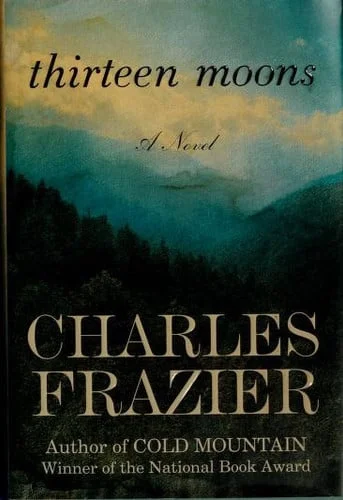
Thirteen Moons: A Novel
by Frazier, Charles · 2006
Own this book?
Catalogue it in your own library: where it is shelved, what you paid, who has borrowed it.
Start your libraryAlready have one? Sign in
Description
From Publishers Weekly
Starred Review. When Frazier's debut Cold Mountain blossomed into a National Book Award–winning bestseller with four million copies in print, expectations for the follow-up rose almost immediately. A decade later, the good news is that Frazier's storytelling prowess doesn't falter in this sophomore effort, a bountiful literary panorama again set primarily in North Carolina's Great Smoky Mountains. The story takes place mostly before the Civil War this time, and it is epic in scope. With pristine prose that's often wry, Frazier brings a rough-and-tumble pioneer past magnificently to life, indicts America with painful bluntness for the betrayal of its native people and recounts a romance rife with sadness. In a departure from Cold Mountain's Inman, Will Cooper narrates his own story in retrospect, beginning with his days as an orphaned, literate "bound boy" who is dispatched to run a musty trading post at the edge of the Cherokee Nation. Nearly nine mesmerizing decades later, Will is an eccentric elder of great accomplishments and gargantuan failures, perched cantankerously on his front porch taking potshots at passenger trains rumbling across his property (he owns "quite a few" shares of the railroad). Over the years, Will--modeled very loosely, Frazier acknowledges, on real-life frontiersman William Holland Thomas--becomes a prosperous merchant, a self-taught lawyer and a state senator; he's adopted by a Cherokee elder and later leads the clan as a white Indian chief; he bears terrible witness to the 1838–1839 Trail of Tears; a quarter-century later, he goes to battle for the Confederacy as a self-anointed colonel, leading a mostly Indian force with a "legion of lawyers and bookkeepers and shop clerks" as officers; as time passes, his life intersects with such figures as Davy Crockett, Sen. John C. Calhoun and President Andrew Jackson. After the Civil War, Will fritters away a fortune through wanderlust, neglect and unquenched longing for his one true love, Claire, a girl he won in a card game when they were both 12, wooed for two erotic summers in his teen years and found again several decades later. In the novel's wistful coda, recalling Claire's voice inflicts "flesh wounds of memory, painful but inconclusive"--a voice that an uncertain old Will hears in the static hiss when he answers his newfangled phone in the book's opening pages. The history that Frazier hauntingly unwinds through Will is as melodic as it is melancholy, but the sublime love story is the narrative's true heart. (Oct. 3) Copyright © Reed Business Information, a division of Reed Elsevier Inc. All rights reserved.
From The Washington Post's Book World/washingtonpost.com
Charles Frazier is an intelligent, occasionally witty author who writes incredibly long-winded, sentimental, soporific novels. His first, Cold Mountain, published nine years ago, was the most unlikely bestseller since Oldest Living Confederate Widow Tells All (1989), by his fellow North Carolinian Allan Gurganus, and the most improbable National Book Award winner since John O'Hara's Ten North Frederick half a century ago. Now Frazier weighs in with Thirteen Moons, which manages to be even longer and even duller than Cold Mountain. No doubt it too will be a huge bestseller.
That Frazier's success parallels Gurganus's is purely coincidental, but it's just about impossible not to remark upon the oddness of the coincidence. As a rule, the American book-buying public has only a limited appetite for Southern-fried fiction, yet Frazier and Gurganus somehow have tapped into it. They deal (Frazier somewhat more skillfully than Gurganus) in what a North Carolina newspaper editor of my long-ago acquaintance used to call shucks-'n'-nubbins, which is loosely defined as tiny ears of corn. Frazier's corn is anything but tiny -- more than 400 pages of it in the case of Thirteen Moons -- but it's corn all the same.
Reading Frazier is like sitting by the cracker barrel for hour after hour and listening to an amiable but impossibly gassy guy who talks real slo
Topics
Browse similar books