
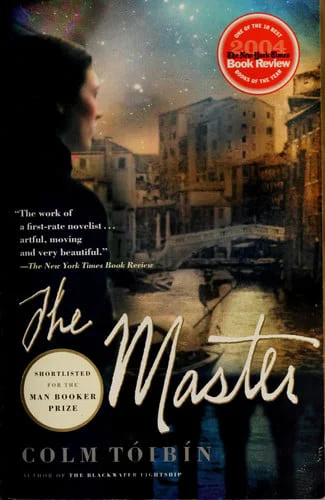
The Master: A Novel
by Toibin, Colm · 2005
Own this book?
Catalogue it in your own library: where it is shelved, what you paid, who has borrowed it.
Start your libraryAlready have one? Sign in
Description
From Publishers Weekly It's a bold writer indeed who dares to put himself inside the mind of novelist Henry James, but that is what Tóibín, highly talented Irish author of The Heather Blazing and The Blackwater Lightship, has ventured here, with a remarkable degree of success. The book is a fictionalized study, based on many biographical materials and family accounts, of the novelist's interior life from the moment in London in 1895 when James's hope to succeed in the theater rather than on the printed page was eclipsed by the towering success of his younger contemporary Oscar Wilde. Thereafter the book ranges seamlessly back and forth over James's life, from his memories of his prominent Brahmin family in the States-including the suicide of his father and the tragic early death of his troubled sister Alice-to his settling in England, in a cherished house of his own choosing in Rye. Along the way it offers hints, no more, of James's troubled sexual identity, including his fascination with a young English manservant, his (apparently platonic) night in bed with Oliver Wendell Holmes and his curious obsession with a dashing Scandinavian sculptor of little talent but huge charisma. Another recurrent motif is James's absorption in the lives of spirited, highly intelligent but unhappy young women who die prematurely, which helped to inform some of his strongest fiction. The subtlety and empathy with which Tóibín inhabits James's psyche and captures the fleeting emotional nuances of his world are beyond praise, and even the echoes of the master's style ring true. Far more than a stunt, this is a riveting, if inevitably somewhat evasive, portrait of the creative life. Copyright © Reed Business Information, a division of Reed Elsevier Inc. All rights reserved. --This text refers to the Hardcover edition.
From The Washington Post's Book World/washingtonpost.com Say, with due reverence, "the Master" and any serious novel-reader instantly knows you are referring to Henry James (1843-1916). No one else in American or English literature comes close to matching James in his austere dedication to the writer's life. From the time of his first story -- about adultery, published in 1865 -- he elected to follow a path of essential loneliness. James mingled with society, dined with the great and the good on two continents, and listened and observed with guarded intensity. He made himself into the most sensitive possible register of social nuance, unspoken yearnings, hidden liaisons. But he remained apart from the fray, looking on the tumultuous, sorrowful human comedy with a pity tempered by compassionate understanding for our failings, sins and wounding misjudgments. Tout comprendre, c'est tout pardonner might almost be James's artistic motto. All his own joys were, to the eyes of the world, muted, perhaps nonexistent. In one of his novels a character proclaims: "Live life. Live all you can. It's a mistake not to," and yet the Master himself seems never to have heeded this liberating affirmation and instead funneled all his animal vitality into the making of such masterpieces as The Portrait of a Lady, "The Turn of the Screw," "The Aspern Papers," The Ambassadors, and that greatest of all accounts of a missed life, "The Beast in the Jungle."
Colm Toibin alludes to each of these novels, novellas and stories (and several others) in this moving portrait of the artist in late middle age. Here the Irish novelist -- hitherto best known for The Blackwater Lightship, which was short-listed for the Booker Prize -- builds on the research and speculations of numerous scholars to construct a novel about James's interior life. This requires the utmost delicacy. In one sense, The Master might almost be viewed as an extreme example of what the French call the vie romancée, a highly embellished form of biography that goes beyond austere scholarship to adopt the exuberance and methods of fiction. Henri Troyat's Tolstoy, for instance, was faulted for being too exciting, too artful, too much like a Tolstoy novel. Similar charges have been leveled at th