
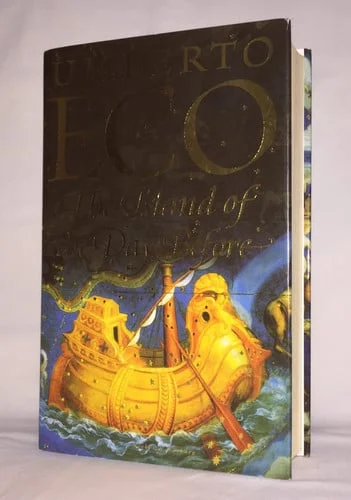
The Island of the Day Before
Originally L' isola del giorno prima
by Eco, Umberto, Weaver, William · 2005
Translated by William Weaver
Own this book?
Catalogue it in your own library: where it is shelved, what you paid, who has borrowed it.
Start your libraryAlready have one? Sign in
Description
From Publishers Weekly
In this tale of an Italian nobleman shipwrecked in the South Pacific in 1643, Eco's storytelling abilities and his love for esoteric historical detail, so beautifully balanced in The Name of the Rose, are sadly out of kilter, with the arcana overwhelming the plot. As part of a cabal instigated by French Cardinal Mazarin and his protege Colbert, Robert della Griva has been traveling in disguise on an English ship whose mission is to discover the Punto Fijo, the means by which navigators can plumb "the mystery of longitude." Cast adrift during a storm, Roberto fetches up against another ship, the Daphne, whose crew has mysteriously vanished. Although the vessel is moored only a mile from an enchanting island (the two may be on opposite sides of the date line, giving the book its title), Roberto, a nonswimmer, is as marooned as though in mid-ocean. The text consists of a third-person narrator's retelling of Roberto's manuscript recounting his adventures on the ship and such previous experiences as his participation in the siege of Casale and life among the erudite of Paris. There are some magical descriptions of Roberto's moonlit solitude aboard the Daphne, but the introduction of a third story line involving his imaginary evil twin hopelessly tangles a narrative already overloaded with lengthy exegeses on such obscure 17th-century devices as the Powder of Sympathy and the Specula Melitensis. Eco's postmodernist games?he directly addresses the reader, explaining how little the narrator knows?wear thin, and some delightfully secondary characters who appear too briefly only remind us how unfocused the novel is. Perhaps Eco himself was aware of the novel's faults when writing it?for his narrator criticizes Roberto's tale as "narrating so many stories at once that at a certain point it becomes difficult to pick up the thread." Author tour. Copyright 1995 Reed Business Information, Inc.
From Library Journal
Eco, an Italian philosopher and best-selling novelist, is a great polymathic fabulist in the tradition of Swift, Voltaire, Joyce, and Borges. The Name of the Rose, which sold 50 million copies worldwide, is an experimental medieval whodunit set in a monastic library. In 1327, Brother William of Baskerville arrives to investigate heresy among the monks in an Italian abbey; a series of bizarre murders overshadows the mission. Within the mystery is a tale of books, librarians, patrons, censorship, and the search for truth in a period of tension between the Papacy and the Holy Roman Empire. The book became a hit despite some obscure passages and allusions. This deftly abridged version, ably performed by Theodore Bikel, retains the genius of the original but is far more accessible. Foucault's Pendulum, Eco's second novel, is a bit irritating. The plot consists of three Milan editors who concoct a series on the occult for an unscrupulous publishing house that Eco ridicules mercilessly. The work details medieval phenomena including the Knights Templar, an ancient order with a scheme to dominate the world. Unfortunately, few listeners will make sense of this failed thriller. The Island of the Day Before is an ingenious tale that begins with a shipwreck in 1643. Roberta della Griva survives and boards another ship only to find himself trapped. Flashbacks give us Renaissance battles, the French court, spies, intriguing love affairs, and the attempt to solve the problem of longitude. It's a world of metaphors and paradoxes created by an entertaining scholar. Tim Curry, who also narrates Foucault's Pendulum, provides a spirited narration. Ultimately, libraries should avoid Foucault's Pendulum, but educated patrons will form an eager audience for both The Name of the Rose and The Island of the Day Before.?James Dudley, Copiague, N.Y. Copyright 1996 Reed Business Information, Inc. --This text refers to an out of print or unavailable edition of this title.
Topics
Browse similar books