
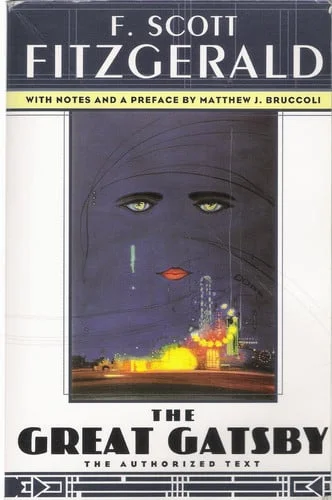
The Great Gatsby
by Fitzgerald, F. Scott, Bruccoli, Matthew Joseph, Bruccoli, Matthew J. · 1995
With contributions by Matthew J. Bruccoli, Cherylynne Li and Francis Cugat
Own this book?
Catalogue it in your own library: where it is shelved, what you paid, who has borrowed it.
Start your libraryAlready have one? Sign in
Description
Amazon.com
In 1922, F. Scott Fitzgerald announced his decision to write "something new--something extraordinary and beautiful and simple + intricately patterned." That extraordinary, beautiful, intricately patterned, and above all, simple novel became The Great Gatsby, arguably Fitzgerald's finest work and certainly the book for which he is best known. A portrait of the Jazz Age in all of its decadence and excess, Gatsby captured the spirit of the author's generation and earned itself a permanent place in American mythology. Self-made, self-invented millionaire Jay Gatsby embodies some of Fitzgerald's--and his country's--most abiding obsessions: money, ambition, greed, and the promise of new beginnings. "Gatsby believed in the green light, the orgiastic future that year by year recedes before us. It eluded us then, but that's no matter--tomorrow we will run faster, stretch out our arms farther.... And one fine morning--" Gatsby's rise to glory and eventual fall from grace becomes a kind of cautionary tale about the American Dream.
It's also a love story, of sorts, the narrative of Gatsby's quixotic passion for Daisy Buchanan. The pair meet five years before the novel begins, when Daisy is a legendary young Louisville beauty and Gatsby an impoverished officer. They fall in love, but while Gatsby serves overseas, Daisy marries the brutal, bullying, but extremely rich Tom Buchanan. After the war, Gatsby devotes himself blindly to the pursuit of wealth by whatever means--and to the pursuit of Daisy, which amounts to the same thing. "Her voice is full of money," Gatsby says admiringly, in one of the novel's more famous descriptions. His millions made, Gatsby buys a mansion across Long Island Sound from Daisy's patrician East Egg address, throws lavish parties, and waits for her to appear. When she does, events unfold with all the tragic inevitability of a Greek drama, with detached, cynical neighbor Nick Carraway acting as chorus throughout. Spare, elegantly plotted, and written in crystalline prose, The Great Gatsby is as perfectly satisfying as the best kind of poem.
From AudioFile
Christopher Reeve's smooth rhythm and soft-spoken tone accentuate Fitzgerald's flowing, elegant style. Since his character is an onlooker to events which take place in Gatsby's glittering but superficial world, Reeve also projects an appropriate distant quality. However, his vocal attempts to make each character well-defined seem to be an overwhelming task for one reader. Occasionally, it is hard to tell which character is speaking. Nonetheless, Reeve's ability to accurately evoke the emotions of the characters transcends this flaw. As a result, he delivers a noteworthy performance. M.P.T. (c)AudioFile, Portland, Maine --This text refers to an out of print or unavailable edition of this title.
Topics
More by Fitzgerald, F. Scott
Books credited to Fitzgerald, F. Scott
Browse similar books