
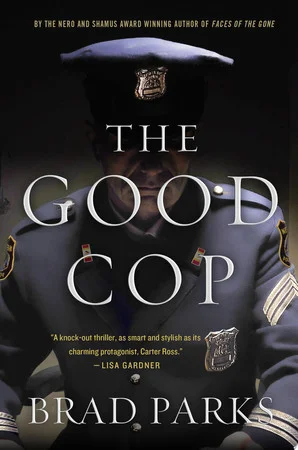
The Good Cop: A Mystery
by Parks, Brad · 2013
Own this book?
Catalogue it in your own library: where it is shelved, what you paid, who has borrowed it.
Start your libraryAlready have one? Sign in
Description
Book Description
As long as Newark Eagle-Examiner reporter Carter Ross turns in his stories on deadline, no one bats an eye if he doesn't wander into the newsroom until 10 or 11 in the morning. So it's an unpleasant surprise when he's awakened at 8:38 a.m. by a phone call from his boss, telling him a local policeman was killed and to get the story. Shaking himself awake, Carter heads off to interview the cop's widow. And then he gets another call: the story's off, the cop committed suicide.
But Carter can't understand why a man with a job he loved, a beautiful wife, and plans to take his adorable children to Disney World would suddenly kill himself. And when Carter's attempts to learn more are repeatedly blocked, it's clear someone knows more than he's saying about the cop's death. The question is, who? And what does he have to hide? Carter, with his usual single-minded devotion to a good story-and to the memory of a Newark policeman-will do whatever it takes to uncover the truth.
In The Good Cop, Brad Parks is back with all the humor, charm, and human insight his readers have come to expect, and more.
Editorial Reviews
About the Author
BRAD PARKS is the first author to win both the Shamus Award and the Nero Award for Best American Mystery for his debut novel, Faces of the Gone. A former reporter for The Washington Post and The [Newark] Star-Ledger, he lives in Virginia, and this is his fourth novel.
Excerpt. ® Reprinted by permission. All rights reserved. CHAPTER 1
Among the many reasons I enjoy being a newspaper reporter-not the least of which are the freedom, the fun, and the constitutionally protected right to announce when people are acting like idiots-one of the small-but-important pleasures is what I'm doing each morning at eight thirty-eight. At 8:38 A.M., I imagine most gainfully employed, industrious members of our society are already enjoined in the struggle that is their daily grind. They have attended to their grooming needs, squeezed themselves into their workaday uniforms, rushed through a meal that puts the "fast" in "breakfast," and made the necessary concessions to their caffeine addictions. At 8:38 A.M., they are inhaling the carbon-tinged exhaust fumes from the car in front of them on the Garden State Parkway; or they are recovering from the latest skirmish in the ongoing Battle of No, You Cannot Wear That to School; or they are checking their e-mails, looking at their schedules, and generally girding themselves for all that is to come. Me? At 8:38 A.M., I do solemnly swear that I, Carter Ross, am asleep. In my profession, this is not necessarily a sign of sloth. Editors typically have established hours, but reporters adapt their schedules to the demands of their beat. Courthouse reporters are at the whim of their trial; education reporters learn to make calls during the school day; sports reporters, the vampires of the journalism world, primarily work at night. As an investigative reporter, I don't have a beat per se. No one expects to see me in the office at any particular time of the day, and certainly not at 8:38 A.M., when most self-respecting American newsrooms are devoid of all but the barest minimum of personnel. Anywhere from ten to eleven is considered a more fashionable arrival time. So I pretty much get up when I feel like it. I have a need to set an alarm maybe five times a year. I often make up for it on the other end because while my day may come in like a lamb, it often goes out like a lion, with sources and editors and deadline all screaming at me simultaneously. My employer, the Newark Eagle-Examiner-New Jersey's largest and most tenacious disseminator of responsibly vetted information-always gets its pound of flesh out of me. Nevertheless, if I do happen to wake up when there is an unsightly number (like an eight or, God forbid, a seven) leading the digital clock by my bedside, I take pride in rolling over and snoozing until I see a more proper number (like a nine or a ten). The main characters in my life-be it my colleagues, my friends, or Deadline, the cat who reliably joins me in my morning slumber-know this about me. So it came as something of a surprise when I became aware that my landline, the number almost no one used anymore, was ringing one sunless Monday morning in March at exactly 8:38 A.M. "Hello?" I said, sounding a bit guttural. "Carter, it's Katie Mossman." Katie was one of the editors on what was formally called the Nonstop News Desk, which had been created a few years back to feed the insatiable content beast that is our Web site. Informally, we reporters called it the All-Slop News Desk-"the Slop" for short-because that's about what we shoveled into it. "What's up, Katie?" "We got a dead Newark cop," she replied, and I immediately sat up in bed and grabbed a notepad. For as much as law enforcement and media sometimes find themselves at odds, we in the Fourth Estate recognize that those who are sworn to uphold the law not only perform a vital function for public safety but represent all of us in doing it. An attack on one of their number is an attack on everyone. Police officers who die in the line of duty are heroes and are treated as such. In other words, dead cops equal big news. "Okay. What do you need from me?" "I don't know. I don't think we have a game plan yet. I just called Tina to tell her about it and she said I should call you and, quote, ‘Get his sorry ass out of bed.'" As the assistant managing editor for local news, Tina Thompson was my boss. She and I also had a fairly complex, on-and-off relationship (currently: off). In both roles, she was not especially shy about expressing her needs. "You can tell her it's out," I said. "What's this cop's name?" "From what we're hearing, it's Darius Kipps. K-I-P-P-S. Detective Sergeant Darius Kipps." The name meant nothing to me. While I wasn't strictly a cops reporter, I had a decent number of contacts in the Newark Police Department. Still, there were more than a thousand cops on the force and I knew only a fraction of them. "What happened to him?" "We don't know that yet, either. The Newark PD hasn't announced any of this. We're just getting this from sources. We haven't even put it online yet because we don't have it confirmed." "So how do we know this mystery cop is dead?" "One of the photogs was listening to the scanner this morning and said there was a lot of chatter about something going down at the Fourth Precinct. We figured it out from there." I knew the Fourth Precinct well. It was in the Central Ward, in the heart of a Newark neighborhood that had been making news, not all of it good, for a long time. "Got it. What does Tina want from me?" "Plans are still being formed. At this point, she just wants everyone in here. It's one of those all-hands-on-deck things." That, of course, was the reaction of most editors to a big story. Gather up your reporters-they sometimes referred to us as "resources" so we wouldn't be confused with human beings-and then figure out what to do with us later. It usually just meant we'd be bumping into one another all day long. But, in truth, the only thing worse than doing all that bumping was being left out of it. I told Katie her message had been delivered, then hung up. There would be no dawdling in bed on this day. Anyone with reporter's blood flowing in his veins-and I fancied myself as having a lot of it-wanted in on a story like this. * * * As a thirty-two-year-old bachelor with no significant encumbrances, I can be showered, dressed, and ready to ramble in fifteen minutes. Twelve if I really push it. I streamline this process in several ways. One, there is nothing complicated about my hair. It's brown and short-never more than four weeks away from being cut-and I part it on the side, the same way I've been doing it since I was old enough to hold a brush. Two, my morning routine involves a bare minimum of lotionry and potionry. I've been told the modern male ought to concern himself with hair product, moisturizer, cologne and/or body spray, and perhaps a half-dozen other products from the health and beauty aisle, all carefully applied and then painstakingly primped. Me, I wear deodorant (primarily out of consideration to my fellow man). Three, my wardrobe is, quite deliberately, the most boring thing you've ever seen. I have two possible colors of pleated slacks (charcoal and khaki), two colors of shirt (white and blue) and three colors of necktie (red, yellow, or blue). And if you notice, any of the twelve resulting color combinations match just fine. So I can pretty much dive into my closet and grab blindly for anything that's clean, knowing I can't miss. The end result of all this is not particularly inspiring-I make a Land's End catalogue look avant-garde by comparison-but it works for me. You have to know what flavor of ice cream you are in this world, and I am vanilla. On this day, my closet dive yielded the racy blend of khaki pants, a white shirt, and a blue tie. I tossed a bit of kibble in a bowl for Deadline-not that he would be awake to eat it for another few hours-then opened my laptop. I had no intention of going into the office to be one of Tina Thompson's "resources," which would just involve sitting around a conference table until someone told me to do what any good reporter should have been doing all along. Sometimes editors just get in the way like that. So I got to work. After about five minutes of accessing a few of the databases on which a reporter makes his living, I learned the late Darius Kipps had been with the Newark Police Department for twelve years and three months. He was thirty-seven years old, having celebrated his birthday on the first of March. He was making $93,140 a year, which is not unusual in a state with the nation's highest paid police officers. He had a variety of addresses associated with him-some in Newark, some in Irvington-but seemed to have settled in East Orange. Sure enough, when I checked the East Orange property tax records, I found a dwelling owned by Noemi and Darius Kipps on Rutledge Avenue. And that, I had already decided as I closed the lid on my laptop, was where I needed to be. This was something of a calculated gamble on my part. Without knowing how Darius Kipps met his untimely end, there was no telling what would figure prominently in our story. But, sadly, I could proffer up a reasonable guess. He was a detective, which is usually a pretty safe place for a cop. Unless, of course, you're undercover. Then you're just as exposed to danger as anyone else who tries to make a life on the streets. If not more so. All it takes is some punk deciding you looked at him the wrong way and, not knowing you're a cop, pulling the trigger. Or maybe something else had befallen Detective Sergeant Kipps. Point is, we had cops reporters who were in a better position to figure it out, leaving me to work other angles. And in...
Topics
More by Parks, Brad
Books credited to Parks, Brad
Browse similar books