
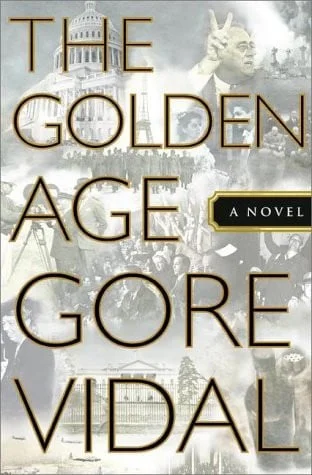
The Golden Age: An American Chronicle Novel
by Vidal, Gore · 2000
Own this book?
Catalogue it in your own library: where it is shelved, what you paid, who has borrowed it.
Start your libraryAlready have one? Sign in
Description
Amazon.com
Since 1967, when he published Washington, D.C., Gore Vidal has been assembling an artful, acidic history of the United States. The Golden Age represents the seventh and final installment of this national epic, covering the years from 1939 to 1954 (with a valedictory fast-forward, in its final pages, to the end of the millennium). As Vidal did in the earlier books, the author sticks pretty rigorously to the facts. Real-life figures--in this case, the likes of Franklin Delano Roosevelt and Harry Truman and that ardent cold warrior Dean Acheson--do what they are recorded to have done. The author also ushers on a cast of invented characters, who are free to paddle in the historical backwash and comment upon their so-called contemporaries. It's here, of course, that fact and fiction begin to blur. But Vidal himself has often cited Tolstoy's famous jab--"History would be an excellent thing if it only were true"--and his reconstruction of FDR's wartime machinations, and the brief interval of Pax Americana, seem persuasively, even alarmingly plausible.
There's one key difference between this book and its predecessors, however. Vidal was alive and kicking in 1939, and thanks to his role as Senator Thomas Pryor Gore's grandson (and occasional seeing-eye dog), he met or at least observed many of The Golden Age's dramatis personae. This fact turns out to have a double edge. On one hand, it gives his portraits of the high and mighty an extra ounce of verisimilitude. Here (the invented) Caroline Sanford observes her old friend FDR at an informal White House mixer: She felt for an instant that she should curtsey in the awesome presence of Franklin Delano Roosevelt, a figure who towered even when seated in his wheelchair. It was the head and neck that did the trick, she decided, with a professional actor's eye. The neck was especially thick while the famous head seemed half again larger than average, its thinning gray hair combed severely back from a high rounded forehead. Like all of Vidal's politicians, FDR is a more or less gifted illusionist, and The Golden Age is one more chapter in the convergence of theater and politics, of Hollywood and Washington, D.C. But the very vividness of these historical actors (in every sense of the phrase) makes the author's invented cast seem a little pale and lifeless. No matter. Even in its occasional longueurs, Vidal's concluding volume is packed with ironic insight and world-class gossip, much of it undoubtedly true. And in the surprisingly metafictional finale, he signs off with a fine display of Heraclitean fireworks, not to mention an encore appearance from his rakish progenitor Aaron Burr--which makes you wonder exactly who created whom. --James Marcus
From Publishers Weekly
The newest entry in Vidal's "narratives of empire" series (which includes Burr, Lincoln and 1876) is a densely plotted, hugely ambitious novel that manages to impress and infuriate in equal measure. A series of historical essays masquerading as a historical novel, it endeavors to present Vidal's philosophy regarding our nation's ascent to global-empire status, from 1939 into the 1950s. The protagonists are Peter Sanford, a prescient young intellectual from a well-to-do family, who helps to found the American Idea, a politically radical journal; his aunt, Caroline Sanford, a former film star who has returned to her D.C. newspaper publishing roots; and Timothy X. Farrell, Caroline's half-brother and an acclaimed documentary filmmaker on the rise in Hollywood. The narrative carries its myriad charactersAincluding FDR, William Randolph Hearst, Tennessee Williams and Vidal himselfAthrough the political machinations that culminate in the bombing of Pearl Harbor, the economic boom engendered by WWII, even the dark years of McCarthyism and the Korean War. However, it is in the misadventures of the cynical yet idealistic Peter Sanford that Vidal advances his powerful (if rather familiar) central thesis. Events include Sanford's brush with politically motivated murder at the 1940 Republican Convention, and a bitter
Topics
More by Vidal, Gore
Books credited to Vidal, Gore