
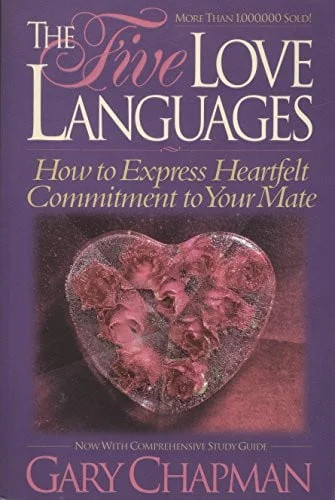
The Five Love Languages: How to Express Heartfelt Commitment to Your Mate
by Chapman, Gary · 2004
Own this book?
Catalogue it in your own library: where it is shelved, what you paid, who has borrowed it.
Start your libraryAlready have one? Sign in
Description
Are you and your spouse speaking the same language? While love is a many splendored thing, it is sometimes a very confusing thing, too. And as people come in all varieties, shapes, and sizes, so do their choices of personal expressions of love. But more often than not, the giver and the receiver express love in two different ways. This can lead to misunderstanding, quarrels, and even divorce. <BR><BR>Quality time, words of affirmation, gifts, acts of service, and physical touch are the five basic love languages. Dr. Gary Chapman identifies these and guides couples towards a better understanding of their unique languages of love. Learn to speak and understand your mate's love language, and in no time you will be able to effectively love and truly feel loved in return. Skillful communication is within your grasp!<BR>
Editorial Reviews
Amazon.com Review Unhappiness in marriage often has a simple root cause: we speak different love languages, believes Dr. Gary Chapman. While working as a marriage counselor for more than 30 years, he identified five love languages: Words of Affirmation, Quality Time, Receiving Gifts, Acts of Service, and Physical Touch. In a friendly, often humorous style, he unpacks each one. Some husbands or wives may crave focused attention; another needs regular praise. Gifts are highly important to one spouse, while another sees fixing a leaky faucet, ironing a shirt, or cooking a meal as filling their "love tank." Some partners might find physical touch makes them feel valued: holding hands, giving back rubs, and sexual contact. Chapman illustrates each love language with real-life examples from his counseling practice.
How do you discover your spouse¬'s ¬ñ and your own ¬ñ love language? Chapman¬'s short questionnaires are one of several ways to find out. Throughout the book, he also includes application questions that can be answered more extensively in the beautifully detailed companion leather journal (an exclusive Amazon.com set). Each section of the journal corresponds with a chapter from the book, offering opportunities for deeper reflection on your marriage.
Although some readers may find choosing to love a spouse that they no longer even like –hoping the feelings of affection will follow later– a difficult concept to swallow, Chapman promises that the results will be worth the effort. "Love is a choice," says Chapman. "And either partner can start the process today." --Cindy Crosby. This text refers to the Amazon.com Exclusive Journal & Paperback Book Set.
From the Back Cover <P align=center><STRONG>ARE YOU AND YOUR SPOUSE <BR>SPEAKING THE SAME LANGUAGE?<BR><BR></STRONG></P><P align=left></P>He sends you flowers when what you really want is time to talk. She gives you a hug when what you really need is a home-cooked meal. The problem isn't your love--it's your love language!<BR><BR>In this international best seller, Dr. Gary Chapman reveals how different people express love in different ways. In fact, there are five specific languages of love:<BR><BR><STRONG>-Quality Time<BR>-Words of Affirmation<BR>-Gifts<BR>-Acts of Service<BR>-Physical Touch</STRONG><BR><BR>What speaks volumes to you may be meaningless to your spouse. But here, at last, is the key to understanding each other's unique needs. Apply the right principles, learn the right language, and soon you'll know the profound satisfaction and joy of being able to express your love--and feeling truly loved in return.<BR>
From the Back Cover <P align=center><STRONG>ARE YOU AND YOUR SPOUSE <BR>SPEAKING THE SAME LANGUAGE?<BR><BR></STRONG></P><P align=left></P>He sends you flowers when what you really want is time to talk. She gives you a hug when what you really need is a home-cooked meal. The problem isn't your love--it's your love language!<BR><BR>In this international best seller, Dr. Gary Chapman reveals how different people express love in different ways. In fact, there are five specific languages of love:<BR><BR><STRONG>-Quality Time<BR>-Words of Affirmation<BR>-Gifts<BR>-Acts of Service<BR>-Physical Touch</STRONG><BR><BR>What speaks volumes to you may be meaningless to your spouse. But here, at last, is the key to understanding each other's unique needs. Apply the right principles, learn the right language, and soon you'll know the profound satisfaction and joy of being able to express your love--and feeling truly loved in return.<BR>
About the Author GARY CHAPMAN, PhD, is the author of the #1 New York Times bestselling The 5 Love Languages. With over 30 years of counseling experience, he has the uncanny ability to hold a mirror up to human behavior, showing readers not just where they go wrong, but also how to grow and move forward. Dr. Chapman holds BA and MA degrees in anthropology from Wheaton College and Wake Forest University, respectively, MRE and PhD degrees from Southwestern Baptist Theological Seminary, and has completed postgraduate work at the University of North Carolina and Duke University. For more information visit his website at www.5lovelanguages.com.
Excerpt. Æ Reprinted by permission. All rights reserved. In the area of love, it is similar. Your emotional love language and the language of your spouse may be as different as Chinese from English. No matter how hard you try to express love in English, if your spouse understands only Chinese, you will never understand how to love each other. My friend on the plane was speaking the language of "Affirming Words" to his third wife when he said, "I told her how beautiful she was. I told her I loved her. I told her how proud I was to be her husband." He was speaking love, and he was sincere, but she did not understand his language. Perhaps she was looking for love in his behavior and didn't see it. Being sincere is not enough. We must be willing to learn our spouse's primary love language if we are to be effective communicators of love.
Topics
More by Chapman, Gary
Books credited to Chapman, Gary
Other editions
Editions linked to the same Open Library work
Browse similar books