
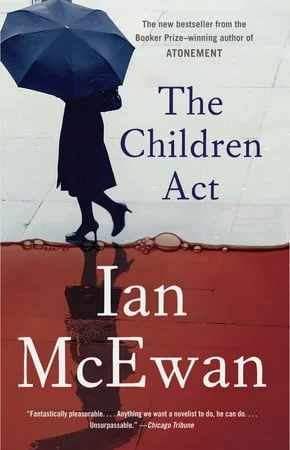
The Children Act
by McEwan, Ian · 2015
Own this book?
Catalogue it in your own library: where it is shelved, what you paid, who has borrowed it.
Start your libraryAlready have one? Sign in
Description
The Children Act by Ian McEwan
One of the Best Books of the Year: The Washington Post, NPR, Vogue, BookRiot
Fiona Maye is a leading High Court judge who presides over cases in the family division. She is renowned for her fierce intelligence, exactitude, and sensitivity. But her professional success belies private sorrow and domestic strife. There is the lingering regret of her childlessness, and now her marriage of thirty years is in crisis. At the same time, she is called on to try an urgent case: Adam, a beautiful seventeen-year-old boy, is refusing for religious reasons the medical treatment that could save his life, and his devout parents echo his wishes. Time is running out. Should the secular court overrule sincerely expressed faith? In the course of reaching a decision, Fiona visits Adam in the hospital--an encounter that stirs long-buried feelings in her and powerful new emotions in the boy. Her judgment has momentous consequences for them both.
Editorial Reviews
"Fantastically pleasurable.... Anything we want a novelist to do, he can do.... Unsurpassable." --Chicago Tribune
"A svelte novel as crisp and spotless as a priest's collar.... Another notable volume from one of the finest writers alive." --The Washington Post
"Masterful.... Begins with the briskness of a legal brief written by a brilliant mind, and concludes with a gracefulness found in the work of few other writers." --Meg Wolitzer, NPR
"Powerful.... Convincingly presents a complex woman in all her nuances.... A paragon becomes all too human in this aching tale." --New York Daily News
"The first thing to do about Ian McEwan is stipulate his mastery. Anything we want a novelist to do, he can do, has done. His books are fantastically pleasurable. Their plots click forward, the characters lifted into real being by his gliding, edgeless, observant, devastating prose--his faultless prose.... Every novelistic mode is at his command, from the dark fabulism of The Child in Time to the vibrant sweep of Atonement to the modest but beautiful realism of his more recent work, On Chesil Beach, Saturday, Solar." --Chicago Tribune
"Highly subtle and page-turningly dramatic.... Only a master could manage, in barely over 200 pages, to engage so many ideas, leaving nothing neatly answered." --The Boston Globe
"It's a joy to welcome The Children Act.... [The novel's] sense of life-and-death urgency never wavers.... Profound.... You would have to go back to Saturday or Atonement to find scenes of equivalent intensity and emotional investment." --The Wall Street Journal
"McEwan here crafts a taut morality tale in crystalline sentences." --O, The Oprah Magazine
"A quietly exhilarating book.... Reveals an uncanny genius for plucking a resonant subject from the pages of lifestyle journalism and teasing it out into full scenes and then pressing them hard for their larger, enduring meanings." --Los Angeles Times
"Powerful.... Heartbreaking and profound.... Skillfully juxtaposes the dilemmas of ordinary life and tabloid-ready controversy." --People
"Smart and elegant.... Reminds us just how messy life can be and how the justice system, despite the best of intentions and the best of minds, doesn't always deliver justice." --USA Today
"A finely written, engaging read.... Poignant, challenging, and lyrical." --The Huffington Post
"Haunting.... [A] brief but substantial addition to the author's oeuvre." --Entertainment Weekly, A-
"One of the most extraordinary, powerful, moving reading experiences of my life.... An utterly remarkable novel, delicately balanced, perfectly crafted, beautifully written." --Alberto Manguel, author of A History of Reading
"Captivating.... Achingly romantic.... Entertain[s] some messy dualities: the limits of the law and the expansiveness of humanity, youth and age, guilt and innocence, the confines of religion and the boundlessness of free thought." --The Houston Chronicle
"Fascinatingly complex and finally heartbreaking.... A quite beautiful work of fiction." --The Times (London) "Masterly.... As one begins an Ian McEwan novel--this is his 13th--one feels an immediate pleasure in returning to prose of uncommon clarity, unshowiness and control.... The best novel he has written since On Chesil Beach." --The Guardian (London)
"As ever, McEwan achieves the rich, fine-grained realistic texture that makes his novels, sentence by sentence, a pleasure to read." --The London Review of Books
"Swift and compelling, asking to be read in a single sitting.... So skillfully composed and fluently performed, it's a pleasure from start to finish, one not to be interrupted.' --Evening Standard (London) - From the Publisher
★ 07/07/2014 The 1989 Children Act made a child's welfare the top priority of English courts--easier said than done, given the complexities of modern life and the pervasiveness of human weakness, as Family Court Judge Fiona Maye discovers in McEwan's 13th novel (after Sweet Tooth). Approaching 60, at the peak of her career, Fiona has a reputation for well-written, well-reasoned decisions. She is, in fact, more comfortable with cool judgment than her husband's pleas for passion. While he pursues a 28-year-old statistician, Fiona focuses on casework, especially a hospital petition to overrule two Jehovah's Witnesses who refuse blood transfusions for Adam, their 17-year-old son who's dying of leukemia. Adam agrees with their decision. Fiona visits Adam in the hospital, where she finds him writing poetry and studying violin. Childless Fiona shares a musical moment with the boy, then rules in the hospital's favor. Adam's ensuing rebellion against his parents, break with religion, and passionate devotion to Fiona culminate in a disturbing face-to-face encounter that calls into question what constitutes a child's welfare and who best represents it. As in Atonement, what doesn't happen has the power to destroy; as in Amsterdam, McEwan probes the dread beneath civilized society. In spare prose, he examines cases, people, and situations, to reveal anger, sorrow, shame, impulse, and yearning. He rejects religious dogma that lacks compassion, but scrutinizes secular morality as well. Readers may dispute his most pessimistic inferences, but few will deny McEwan his place among the best of Britain's living novelists. (Sept.) - Publishers Weekly
09/01/2014 Obsession is a familiar subject for McEwan, most memorably explored in his 1997 Enduring Love. This time the theme is a touchstone in a novel exploring a man's fixation on having an open marriage, a boy's fascination with the judge who will decide his fate, and a couple's determination to follow the strictures of their religion no matter the cost. The judge, Fiona Maye, must decide whether the teenage boy, a devout Jehovah's Witness, can be forced by the court to undergo the blood transfusion that is necessary to save his life. Clouding Maye's mind is turmoil at home: her husband is calmly insisting upon changing the boundaries of their relationship, a story line that will remind readers of the excruciating tiptoeing-around-each-other executed in the author's On Chesil Beach. In the end, this nuanced work explores compelling ideas but is not as memorable as McEwan's best. It may find a wider audience than some of his works, though, as its setting is contemporary and its major plotline--religious exemptions to laws--topical. VERDICT Purchase where McEwan, literary fiction, and explorations of social dilemmas are popular. [See Prepub Alert, 5/19/14.]--Henrietta Verma, Library Journal - Library Journal
★ 2014-07-23 In the late summer of 2012, a British judge faces a complex case while dealing with her husband's infidelity in this thoughtful, well-wrought novel. Fiona Maye, at 59, has just learned of an awful crack in her marriage when she must rule on the opposing medical and religious interests surrounding a 17-year-old boy who will likely die without blood transfusions. The cancer patient, weeks shy of the age when he could speak for himself, has embraced his parents' deep faith as Jehovah's Witnesses and their abhorrence of letting what the Bible deems a pollutant enter his body. The scenes before the bench and at the boy's hospital bedside are taut and intelligent, like the best courtroom dramas. The ruling produces two intriguing twists that, among other things, suggest a telling allusion to James Joyce's 17-year-old Michael Furey in "The Dead." Meanwhile, McEwan (Sweet Tooth, 2012, etc.), in a rich character study that begs for a James Ivory film, shows Fiona reckoning with the doubt, depression and temporary triumphs of the betrayed--like an almost Elizabethan digression on changing the locks of their flat--not to mention guilt at stressing over her career and forgoing children. As Fiona thinks of a case: "All this sorrow had common themes, there was a human sameness to it, but it continued to fascinate her." Also running through the book is a musical theme, literal and verbal, in which Fiona escapes the legal world and "the subdued drama of her half-life with Jack" to play solo and in duets. McEwan, always a smart, engaging writer, here takes more than one familiar situation and creates at every turn something new and emotionally rewarding in a way he hasn't done so well since On Chesil Beach (2007). - Kirkus Reviews
Topics
More by McEwan, Ian
Books credited to McEwan, Ian