
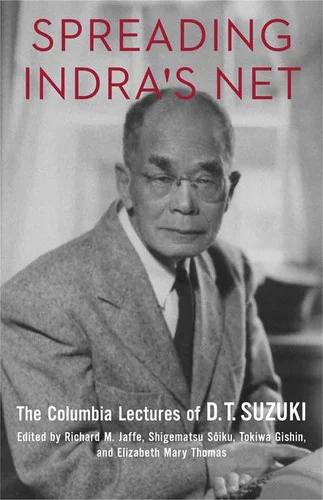
Spreading Indra's Net
by Richard M. Jaffe, D. T. Suzuki, Shigematsu Sōiku, Tokiwa Gishin · 2025
Own this book?
Catalogue it in your own library: where it is shelved, what you paid, who has borrowed it.
Start your libraryAlready have one? Sign in
Description
"D. T. Suzuki entered the faculty of Union Theological Seminary in 1951 through a Rockefeller Foundation grant and soon joined the Department of Chinese and Japanese at Columbia University, where he remained until 1957. His lectures drew not only Columbia students but also many notable intellectual and cultural leaders, sometimes as many as forty at a time, including John Cage, Arthur Danto, Phillip Guston, Abraham Kaplan, Ibram Lassaw, and Agnes Martin, many of whom later claimed to have been deeply influenced by Suzuki's classes. Arthur Danto even suggested that intellectually and culturally Suzuki's lectures played a role in 1950s New York intellectual life similar to that exercised by Alexandre Kojève's course on Hegel's Phenomenology of Spirit at the Collège de Paris in the 1930s. The Columbia lectures comprise one of the most comprehensive presentations of Suzuki's approach to Buddhism available among his many published writings. He wove together a number of distinct threads from nearly a half-century of writing in English and Japanese. In particular, he lectured extensively on the relationship between Zen and such foundational Mahayana texts as The Awakening of Faith, providing some of the clearest examples of how Suzuki understood the connection between Chan/Zen and the broader Mahayana tradition. Suzuki also connects his understanding of Zen and Mahayana to Christianity, existentialism, and other currents in contemporaneous American and European thought in an effort to explain Buddhism to his American audience. All together, the lectures provide a vivid example of how one of the most important Buddhist intellectuals of the twentieth century interpreted Zen as a modernist tradition and understood its relationship to global intellectual currents"-- Provided by publisher.
Topics
More by D. T. Suzuki
Books credited to D. T. Suzuki