
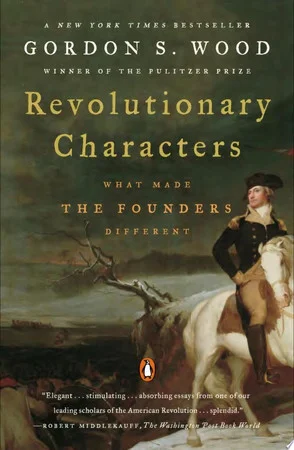
Revolutionary Characters: What Made the Founders Different
by Wood, Gordon S. · 2007
Own this book?
Catalogue it in your own library: where it is shelved, what you paid, who has borrowed it.
Start your libraryAlready have one? Sign in
Description
Editorial Reviews From Publishers Weekly Bancroft and Pulitzer Prize–winner Wood suggests that behind America's current romance with the founding fathers is a critique of our own leaders, a desire for such capable and disinterested leadership as was offered by George Washington and Thomas Jefferson. Provocatively, Wood argues that the very egalitarian democracy Washington and Co. created all but guarantees that we will "never again replicate the extraordinary generation of the founders." In 10 essays, most culled from the New York Review of Books and the New Republic, Wood offers miniature portraits of James Madison, Aaron Burr, Alexander Hamilton and Thomas Paine. The most stimulating chapter is devoted to John Adams, who died thinking he would never get his due in historians' accounts of the Revolution; for the most part, he was right. This piece is an important corrective; Adams, says Wood, was not only pessimistic about the greed and scrambling he saw in his fellow Americans, he was downright prophetic--and his countrymen, then and now, have never wanted to reckon with his critiques. Wood is an elegant writer who has devoted decades to the men about whom he is writing, and taken together, these pieces add perspective to the founding fathers cottage industry. (May 22) Copyright © Reed Business Information, a division of Reed Elsevier Inc. All rights reserved. --This text refers to the Hardcover edition.
From School Library Journal Adult/High School–There is no shortage of new titles assessing the character and contributions of America's founders, but this excellent book is particularly well suited to high school students. Wood has selected eight remarkable men to profile: George Washington, Benjamin Franklin, Thomas Jefferson, Alexander Hamilton, James Madison, John Adams, Thomas Paine, and Aaron Burr. After describing how their reputations have undergone changes through the years, sometimes honored, sometimes reviled, the author discusses the men in terms of their own times. A chapter is devoted to each one, but these essays are not simple biographical sketches. Wood establishes his subjects' social and economic backgrounds, but then focuses on their personalities and philosophies, revealed through their correspondence. Trying to establish a meritocracy during an age of aristocracy was a daunting process, and the founders often became one another's adversaries. Their shrewd and sometimes caustic observations showed the difficulties involved in coming to a consensus on vital issues. Insecurities, humor, brilliance, and bewilderment abounded, all described in a flowing, lively style. Readers will gain a new understanding and appreciation of these men, and may even be inspired to read some of the comprehensive biographies recommended by the author.–Kathy Tewell, Chantilly Regional Library, Fairfax County, VA Copyright © Reed Business Information, a division of Reed Elsevier Inc. All rights reserved. --This text refers to the Hardcover edition.
Topics
More by Wood, Gordon S.
Books credited to Wood, Gordon S.