
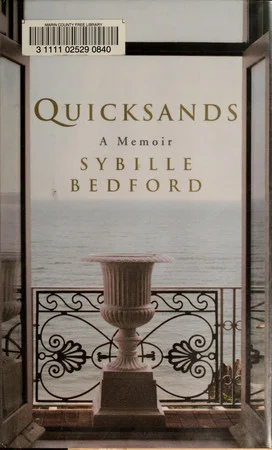
Quicksands: A Memoir
by Bedford, Sybille · 2006
Own this book?
Catalogue it in your own library: where it is shelved, what you paid, who has borrowed it.
Start your libraryAlready have one? Sign in
Description
From Publishers Weekly
This passionate memoir reflects a sharp, incisive interiority and is written in a style that's even more lyrical and engaging than the style that propelled Bedford into the literary world with her first book, Sudden View, in 1953. Mentored by Aldous Huxley (she later wrote his definitive biography), raised in a Europe struggling to retain and later regain its soul, Bedford (b. 1911) crossed paths with many compelling characters in the years during, between and after the world wars, including a few close to Hitler and to the Fascists. Her detailed autobiography is also a memoir of the evolution of an author, and Bedford writes as movingly of 9/11 as she does of the occupation and liberation of Europe. Bedford counters the perils of political darkness with the first flushes of romantic passions, and, throughout, describes the landscape of her world: her youth in the countrysides of Europe, and her adulthood in London, Paris, Berlin, Rome, Florence and New York. Her eye and ear for the ever-changing and challenging world in which she has lived moves her seamlessly from one era to the next. It's heady stuff, no less so for Bedford's ruminative style, her introspection and insight. Agent, Kim Witherspoon. (Apr.) --This text refers to the
Hardcover edition.
From The Washington Post's Book World/washingtonpost.com
Evelyn Waugh called her first novel, A Legacy (1956), "entirely delicious.... cool... elegant." To Bruce Chatwin, A Visit to Don Otavio (1953), her travel book about Mexico, was a model of the genre, not least because of its stylishly witty prose. Similarly, her account of a celebrated English murder case, The Trial of Dr. Adams (1958), set a new standard for true-crime reporting, even as her two-volume biography of Aldous Huxley (1973, 1974) remains the fullest and most enjoyable life of that polymath.
Born in 1911, Sybille Bedford is nearly the last great representative of those amusing and intelligently cosmopolitan women writers who came to prominence in 1950s Britain: Nancy Mitford, Barbara Pym, Iris Murdoch, Muriel Spark (still with us). She has written only four novels -- the others are A Favourite of the Gods (1962), A Compass Error (1968), and Jigsaw (1989) -- and all of them are, more or less, autobiographical. Again and again, she takes up her privileged family heritage (upper-class German, both Jewish and Catholic), her girlhood in France with a feckless art-connoisseur father, her adolescence in Italy with a beautiful, promiscuous mother, and her coming of age in Sanary on the Côte d'Azur, surrounded by eminent artists and writers (Thomas Mann and Huxley, above all), in the company of her restless Italian stepfather (15 years her mother's junior) and periodically exhilarated or wounded by heartbreaking infatuations.
In Quicksands, Bedford returns again to her seductive parents and gypsyish early years, but now forgoes all the convenient chutes and ladders of art. Instead she recalls episodes (more Jigsaw than A Legacy), in a jagged, semi-conversational mode, "an amalgam of fragments." As she announces at the opening, "I shall begin as I hope to continue: from the middle." Stendhal has long been one of Bedford's heroes, and her memoir possesses something of the same dynamic as that novelist's autobiographical Life of Henry Brulard. So Quicksands shifts constantly between the past and the present, between an older writer's interpretative understanding and a younger self's emotional experience. Like Stendhal, too, Bedford possesses a compassionate, autumnal view of the world, as well as a darting, quicksilver prose. She can be lyrical in her descriptions, but her intelligence is fundamentally dry, unblinkered, without illusion. In brief, she is what we Americans regard as a cultivated European, one who lives not for wealth or fame or power but for the petits plaisirs of life. As she says:
"Oh what has remained undone by sloth, discouragement, and of course distractions... Distractions of living the siren song of the daily round -- chance, often choice had led me to sp
Topics
More by Bedford, Sybille
Books credited to Bedford, Sybille