
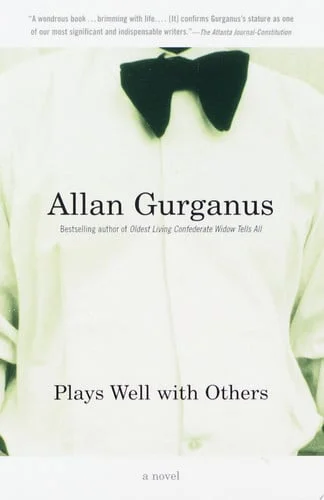
Plays Well With Others
by Gurganus, Allan, Anderson, Peter A. (Designed by) · 1999
Own this book?
Catalogue it in your own library: where it is shelved, what you paid, who has borrowed it.
Start your libraryAlready have one? Sign in
Description
Overview With great narrative inventiveness and emotional amplitude, Allan Gurganus gives us artistic Manhattan in the wild 1980s, where young artists--refugees from the middle class--hurl themselves into playful work and serious fun. Our guide is Hartley Mims Jr., a Southerner whose native knack for happiness might thwart his literary ambitions. Through his eyes we encounter the composer Robert Christian Gustafson, an Iowa preacher's son whose good looks constitute both a mythic draw and a major limitation, and Angelina "Alabama" Byrnes, a failed deb, five feet tall but bristling with outsized talent. These friends shelter each other, promote each other's work, and compete erotically. When tragedy strikes, this circle grows up fast, somehow finding, at the worst of times, the truest sort of family.
Funny and heartbreaking, as eventful as Dickens and as atmospheric as one of Fitzgerald's parties, Plays Well with Others combines a fable's high-noon energy with an elegy's evening grace. Allan Gurganus's celebrated new novel is a lovesong to imperishable friendship, a hymn to a brilliant and now-vanished world. Read More Show Less
Editorial Reviews
From the Publisher "A wondrous book..brimming with life.... [It] confirms Gurganus's stature as one of our most significant and indispensable writers." --Atlanta Journal & Constitution
"Gurganus, a storyteller in the grand tradition, can tell his stories as well as anyone alive." --The New York Times
"Witty and piercing. There are sentences that glisten like black opals." --Los Angeles Times
Publishers Weekly - Publisher's Weekly La vie boheme in New York City in the 1980s is the setting of Gurganus's (Oldest Living Confederate Widow Tells All) fierce, bleakly funny and resonant new novel. The twist here is that the narrator, Richard Hartley Mims Jr., and most of the other characters, are gay. In the heady years when it was chic to come out of the closet, a group of young, ambitious artists, musicians and writers descend on Manhattan from all parts of the country, possessed of talent, joie de vivre and the determination to succeed. They play the party scene, work at menial jobs to support themselves and enjoy the firm conviction that someday they will be famous. Initially, Hartley's discursive, episodic (perhaps semi-autobiographical) chronicle sometimes veers into self-absorbed prattle as he recalls his years growing up in conservative North Carolina, his fledgling efforts as a writer and his sexually charged friendship with the decade's most gorgeous man, genius composer Robert Gustafson, and with outrageous, androgynous artist Angie (aka "Alabama") Byrnes. These somewhat tedious asides are redeemed by hilarious scenes that verge on farce (30 dildoes fall out of a bag on the subway; two of Hartley's suitors meet in his closet and can't resist making love to each other). The specter of AIDs hovers over the novel, however, and gradually transforms the raunchy and pun-prone narrative into a wrenching threnody to lost youth and talent cut down. When the pandemic strikes and Hartley becomes a caretaker to his dying friends, Gurganus's gallows humor and innate compassion transform this material into a wrenching elegy for an innocent time when, to the gay community, artistic fulfillment, fame, love and happiness seemed just within reach. 100,000 first printing; Random House audio. (Nov.)
Library Journal A lucky lottery winner in Grange, Florida, gets madand then gets evenwhen two thugs who won half the pot get greedy and steal her ticket, too.
Salon As the AIDS epidemic approaches the end of its second decade, a new kind of AIDS literature has begun to appear -- a fiction that seeks not just to absorb and comprehend the awful tragedy the disease has wrought in the lives of gay men in America, but to affirm it, to reclaim it in the name of its victims, to celebrate it, even. "We have all been upstaged by the newsworthiness of our particular disaster," Allan Gurganus writes in the prologue to Plays Well with Others, his hilarious, overlong, but ultimately moving account of three young artists in Manhattan in the 1980s, a decade that began with such lustful promise and ended with so many corpses: "This is just one of the ways History snubs us."
Plays Well with Others is the memoir of one Hartley Mims Jr., an eager young talent from North Carolina, already in his early 30s when the novel begins, who aspires at first to be a painter but moves toward writing in fairly short order. In his mind, the line between one creative endeavor and another is almost completely blurred by ambition, sex, high spirits, good friends and the sheer throbbing energy of the magic city.
"For me, New York meant the chance of having fun while creating something true and beautiful," says Hartley, "a chance of lowering my address book's bucket into the deepest, coolest waters I could find." The image of Hartley's address book (or, rather, books, since he goes through nine or 10 of them as his friends begin to die) presides over the novel like the guest list of the "Titanic" -- a not incidental comparison, since Hartley's friend and heartthrob, the composer Robert Gustafson, is working on a "Titanic" symphony before, during and after his descent into AIDS. Robert is a breathtakingly beautiful Midwestern composer, "the greatest beauty of the 1970s Manhattan nights... intensely popular at steam baths and in the backs of parked trucks along West Street where forthright boys passed fluids to and fro, past jets of spit and spunk, a secret virus riding all that liquid living pleasure." Neither Hartley as a narrator nor Gurganus as an author makes any kind of apology for the behaviors that led a whole generation of gay men to their doom.
"O, I long to tell a Fairy Tale," Gurganus cries. "It is a true one. Not to give away the end, but most of the best fairies die... We were children. We thought no one had ever been wilder or smarter than we." That Gurganus is a "Southern" writer becomes almost painfully apparent as his tale progresses; I found the novel rather too thick with phrase, too self-consciously "playful." It's also too intent on crafting and shaping the thoughts and reactions of its characters -- not just Hartley, but Gustafson, too, and their wise, hard-as-nails, ex-debutante companion, painter Alabama Byrnes, whose "weird combination of garden-party girlishness and toad-collecting male-childness" serves as a predictable foil and mirror for the "fairies" at the heart of the story.
On the other hand, anyone who can write the simple declarative sentence "Thirty dildoes are a lot of dildoes" knows which side his book is buttered on. This is a wickedly funny novel, unsentimental, free of self-exculpation and determined to keep a bright face on things despite the subject matter. "Don't worry," says Hartley/Gurganus, "I can still be amusing. They always liked that in me." -- Peter Kurth
Kirkus Reviews A deft mixture of contrasting tones distinguishes this vigorous novel about the New York art scene "Before" and "After" the Age of AIDS, by the gifted author of Oldest Living Confederate Widow Tells All (1989) and White People (stories: 1991).
Narrator Hartley Mims, a writer who migrated in 1980, when he was in his early 30s, from Falls, North Carolina, to Manhattan, begins his story with a Prologue set 14 years later, on the occasion of the horrifying, lingering death of his friend and soulmate Robert Gustafson, long renowned as "the prettiest boy in New York," though only minimally acclaimed as the composer of an ambitious musical work whose theme is the launching and sinking of the Titanic. That image, along with several equally telling monitory metaphors (a street mugging that causes scarring and temporary blindness, friends first meeting at a VD clinic, Mahler's "Songs for Dead Children"), casts an ominous shadow over vividly evoked scenes of erotic play, artistic (and artful) posturing and clowning, and the up-and-down friendships that bond Hartley forever with his beloved (bisexual) Robert, their best gal-pal, heterosexual Angelina "Alabama" Byrnes (a Jackson Pollocklike painter with a splash or two of real genius), and several other intimates who, like Hartley, exercise their gayness in a feverish atmosphere that only gradually reveals its lethal malignity. The writing is pure pleasure throughout: alert, witty, and studded with virtuoso phrasemaking. Yet one must object that by sentimentalizing his characters as doomed "children" (a theme adumbrated by the witty title), Gurganus risks robbing them of their dignity as responsible adults. The point, of course, is that they're both.
Gurganus may not, therefore, be the spokesman for his generation that Plays Well seems to claim, but he's unquestionably one of its most provocative and interesting stylists.
Topics
Next in this series
Vintage Contemporaries Series, by recorded position — this book’s position is not recorded
Also in this series, position not recorded
More by Gurganus, Allan
Books credited to Gurganus, Allan
Browse similar books