
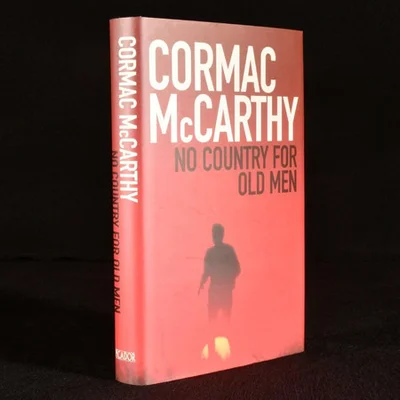
No Country for Old Men
by Mccarthy, Cormac · 2005
Own this book?
Catalogue it in your own library: where it is shelved, what you paid, who has borrowed it.
Start your libraryAlready have one? Sign in
Description
From Publishers Weekly
Starred Review. Seven years after Cities of the Plain brought his acclaimed Border Trilogy to a close, McCarthy returns with a mesmerizing modern-day western. In 1980 southwest Texas, Llewelyn Moss, hunting antelope near the Rio Grande, stumbles across several dead men, a bunch of heroin and $2.4 million in cash. The bulk of the novel is a gripping man-on-the-run sequence relayed in terse, masterful prose as Moss, who's taken the money, tries to evade Wells, an ex–Special Forces agent employed by a powerful cartel, and Chigurh, an icy psychopathic murderer armed with a cattle gun and a dangerous philosophy of justice. Also concerned about Moss's whereabouts is Sheriff Bell, an aging lawman struggling with his sense that there's a new breed of man (embodied in Chigurh) whose destructive power he simply cannot match. In a series of thoughtful first-person passages interspersed throughout, Sheriff Bell laments the changing world, wrestles with an uncomfortable memory from his service in WWII and--a soft ray of light in a book so steeped in bloodshed--rejoices in the great good fortune of his marriage. While the action of the novel thrills, it's the sensitivity and wisdom of Sheriff Bell that makes the book a profound meditation on the battle between good and evil and the roles choice and chance play in the shaping of a life. Copyright © Reed Business Information, a division of Reed Elsevier Inc. All rights reserved.
From The Washington Post's Book World/washingtonpost.com
For 40 years, since The Orchard Keeper, Cormac McCarthy has brought forth literature as important as it is rare. Beyond that, critics and readers tend to diverge wildly with each novel, which to my eye is further proof of the writer's power. No Country for Old Men will have the same effect. This is a profoundly disturbing and gorgeously rendered novel that will certainly be quibbled with. Not the least of the objections will almost surely be what makes the novel so attractive. No Country for Old Men is the most accessible of all McCarthy's works. This is not necessarily a good thing.
The plot is simple. One fine morning in west Texas, a young Vietnam vet is antelope hunting when he comes upon the carnage of a drug deal gone bad. Both heroin and a suitcase of cash remain at the site, along with a number of bodies. The cash is enough to entice the otherwise upright Llewelyn Moss to steal it, although conveniently it's not so much that it can't be carried, not even after Moss receives the first in a long line of wounds. Moss has a moral clarity reminiscent of John Grady Cole from All the Pretty Horses (1992); he knows he's making the worst mistake of his life but can't resist the temptation or the chance to test himself. He knows he'll be hunted (and hunted he is) but believes he can outsmart the hunters.
The other two main characters enter as polarities: a psychopathic killer, Anton Chigurh, whose only apparent moral code is to leave no witnesses to his existence; and Sheriff Bell, a World War II veteran who's a bit smarter than most other law enforcement officers and does his best to find and protect Moss while offering thoughts on existence and the unhinged modern world. The sheriff has his own dark secret which, unfortunately, is somewhat at odds with his character.
Finally, other than a handful of minor characters, there are three women -- or two and a half, depending how you count. The wives of Moss and Bell are tough, tender women, rock-solid square behind their men. The third has the same potential but like most everyone in the novel winds up dead first.
McCarthy's language is stripped lean and mean here. In places, dialogue carries large sections of the story. His ear for speech, dialect and wordplay remains noteworthy in American letters. His descriptive passages are lucid and visual -- this novel needs no film adaptation. He writes in painstaking and painful detail about self-treatment of gunshot wounds, exhibiting a near-morbid fascination that's beyond the call of the narrative. Even what in previous novels
Topics
More by Mccarthy, Cormac
Books credited to Mccarthy, Cormac
Browse similar books