
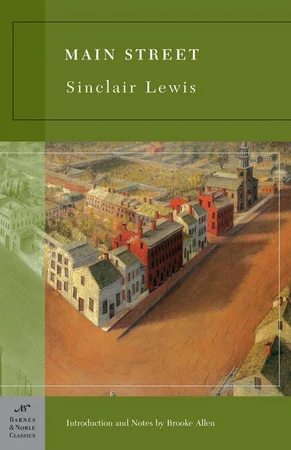
Main Street (Barnes & Noble Classics Series)
by Lewis, Sinclair, Allen, Brooke (Introduction) · 2003
Own this book?
Catalogue it in your own library: where it is shelved, what you paid, who has borrowed it.
Start your libraryAlready have one? Sign in
Description
Book Description
Main Street, by Sinclair Lewis, is part of the Barnes & Noble Classics series, which offers quality editions at affordable prices to the student and the general reader, including new scholarship, thoughtful design, and pages of carefully crafted extras. Here are some of the remarkable features of Barnes & Noble Classics: New introductions commissioned from today's top writers and scholars Biographies of the authors Chronologies of contemporary historical, biographical, and cultural events Footnotes and endnotes Selective discussions of imitations, parodies, poems, books, plays, paintings, operas, statuary, and films inspired by the work Comments by other famous authors Study questions to challenge the reader's viewpoints and expectations Bibliographies for further reading Indices & Glossaries, when appropriateAll editions are beautifully designed and are printed to superior specifications; some include illustrations of historical interest. Barnes & Noble Classics pulls together a constellation of influences-biographical, historical, and literary-to enrich each reader's understanding of these enduring works. "This is America-a town of a few thousand, in a region of wheat and corn and dairies and little groves." So Sinclair Lewis-recipient of the Nobel Prize and rejecter of the Pulitzer-prefaces his novel Main Street. Lewis is brutal in his depictions of the self-satisfied inhabitants of small-town America, a place which proves to be merely an assemblage of pretty surfaces, strung together and ultimately empty.
Brooke Allen holds a Ph.D. in English literature from Columbia University. She is a book critic whose work has appeared in numerous publications including The Atlantic Monthly, The New Criterion, The New York Times Book Review, The Wall Street Journal, The Hudson Review, and The New Leader. A collection of her essays, Twentieth Century Attitudes, will be published in 2003.
Editorial Reviews
About the Author Sinclair Lewis (1885-1951) won the Nobel Prize for Literature in 1930, the first American novelist to be so honored. Born in Minnesota, he attended Yale University but left before graduation to work in Upton Sinclair's socialist colony at Helicon Hall in Englewood, New Jersey. Unable to make a living as a freelance writer, he returned to Yale and earned his degree. In 1914, he published his first novel, Our Mr. Wrenn: The Romantic Adventures of a Gentle Man. But it was not until his sixth novel, Main Street, that he won recognition as an important American novelist. His other major works include Babbitt, Arrowsmith, Elmer Gantry, Dodsworth, and It Can't Happen Here, which he also wrote as a play. Lewis was a prolific writer, publishing dozens of books and innumerable articles throughout his career. Lloyd James has been narrating since 1996, has recorded over six hundred books in almost every genre, has earned six AudioFile Earphones Awards, and is a two-time nominee for the prestigious Audie Award. His bestselling and most critically acclaimed performances include Elvis in the Morning by William F. Buckley, Jr., Ben Hur by Lew Wallace, Searching for Bobby Fischer by Fred Waitskin, and Mystic Warrior by Tracy and Laura Hickman. Lloyd's background as a performer includes extensive work in classical theater and folk music. He lives in Maryland with his wife and children. --This text refers to the Audio CD edition.
Excerpt. ® Reprinted by permission. All rights reserved. From Brooke Allen's Introduction to Main Street
Main Street is very, very American, but it is not purely American. Shaw, in his characteristically flippant manner, spoke the truth when he said that Lewis's criticisms applied to other nations as well, but that Americans clung to the idea that they were unique in their faults (Literary Digest, December 6, 1930); the British novelist John Galsworthy remarked, truly, that "Every country, of course, has its Main Streets" (Lewis, From Main Street to Stockholm: Letters of Sinclair Lewis, 1919-1930). Still, a disdain for intellect (or for what we nowadays prefer to denigrate as elitism) has been particularly marked in America, perhaps because of our commitment, stated if not practiced, to egalitarian democracy: On Main Street, Lewis writes, "to be ‘intellectual' or ‘artistic' or, in their own word, to be ‘highbrow,' is to be priggish and of dubious virtue."
More than eighty years after Lewis's novel this is true, and it is true not only on Main Street but on Wall Street as well, and on Park Avenue, and on Pennsylvania Avenue. This is what makes Main Street such a stunning achievement: While it succeeds in being "contemporary history," capturing a particular place at a particular moment in time, it also speaks for our own time; it is remarkable how much of Main Street is still pertinent. Gopher Prairie at war is not so very unlike our own flag-waving "war on terrorism." Will Kennicott's breezy dismissal of legal procedure-"Whenever it comes right down to a question of defending Americanism and our constitutional rights, it's justifiable to set aside ordinary procedure"-can be read on almost any editorial page today. Gopher Prairie's commercial ethos of material "progress" at the expense of every other variety, an idea Lewis would expand and crystallize in Babbitt, has been refined rather than improved in our own era of no-collar workers who meditate or practice yoga before closing the Big Deal rather than smoking cigars and guzzling alcohol.
Lewis, unlike so many of his contemporaries, was never tempted to look for an answer in political dogma: He hated dictatorships and had no particular faith in the virtue or good judgment of "the people." All he really believed in was the wavering, imperfect liberal spirit: "Even if Com[munism] & Fax[cism] or both cover the world, Liberal[ism] must go on, seeming futile, preserving civilization," he wrote in his notes for It Can't Happen Here (quoted in Lingeman).
An atheist with no political illusions, two failed marriages, an unconquerable addiction to alcohol, and a moribund talent might be thought to have had every reason to give up in despair. Lewis, to his undying credit, did not. "It is a completely revelatory American tragedy," he said in his Nobel Prize speech, "that in our land of freedom, men like [Hamlin] Garland, who first blast the roads to freedom, become themselves the most bound." This has been true of many; it was never true of Lewis. Like Carol Kennicott, he was still reaching-though generally failing to grasp-right up to the end. His particular type of sociological fiction had gone out of fashion at the time of his death, and he continued to be undervalued for decades afterward. But in recent years we have returned to an appreciation for what he accomplished artistically. For what he was able to tell us about American life, in his day and in ours, we can only be grateful.
Topics
Browse similar books