
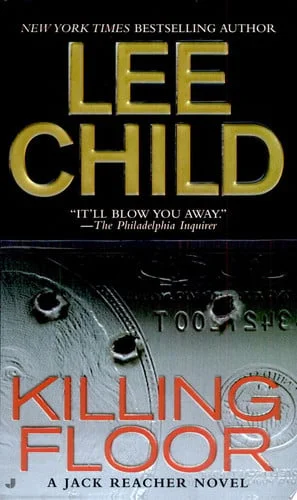
Killing Floor
by Child, Lee · 2006
Own this book?
Catalogue it in your own library: where it is shelved, what you paid, who has borrowed it.
Start your libraryAlready have one? Sign in
Description
Overview All is not well in Margrave, Georgia.
The sleepy, forgotten town hasn't seen a crime in decades, but within the span of three days it witnesses events that leave everyone stunned. An unidentified man is found beaten and shot to death on a lonely country road. The police chief and his wife are butchered on a quiet Sunday morning. Then a bank executive disappears from his home, leaving his keys on the table and his wife frozen with fear.
The easiest suspect is Jack Reacher - an outsider, a man just passing through. But Reacher is not just any drifter. He is a tough ex-military policeman, trained to think fast and act faster. He has lived with and hunted the worst: the hard men of the American military gone bad.
Annotation A former military cop hunts down his brother's killers in this searing tale of revenge and honor. The sleepy, forgotten town of Margrave, Georgia, hasn't seen a crime in decades, but within the span of three days it witnesses crimes that leave everyone stunned. BOMC Alternate. 368 pp. 35,000 print.
From Barnes & Noble The Fan Letter by Lee Child
They say the past is another country, and in my case it really was: provincial England at the end of the fifties and the start of the sixties, the last gasp of the post-war era, before it surrendered to the tectonic shift sparked by the Beatles. My family was neither rich nor poor, not that either condition had much meaning in a society with not much to buy and not much to lack. We accumulated toys at the rate of two a year: one on our birthdays, and one at Christmas. We had a big table radio (which we called "the wireless") in the dining room, and in the living room we had a black and white fishbowl television, full of glowing tubes, but there were only two channels, and they went off the air at ten in the evening, after playing the National Anthem, for which some families stood up, and sometimes we saw a double bill at the pictures on a Saturday morning, but apart from that we had no entertainment.
So we read books. As it happens I just saw some old research from that era which broke down reading habits by class (as so much was categorized in England at that time) and which showed that fully fifty percent of the middle class regarded reading as their main leisure activity. The figure for skilled workers was twenty-five percent, and even among laborers ten percent turned to books as a primary choice.
Not that we bought them. We used the library. Ours was housed in a leftover WW2 Nissen hut (the British version of a Quonset hut) which sat on a bombed-out lot behind a church. It had a low door and a unique warm, musty, dusty smell, which I think came partly from the worn floorboards and partly from the books themselves, of which there were not very many. I finished with the children's picture books by the time I was four, and had read all the chapter books by the time I was eight, and had read all the grown-up books by the time I was ten.
Not that I was unique - or even very bookish. I was one of the rough kids. We fought and stole and broke windows and walked miles to soccer games, where we fought some more. We were covered in scabs and scars. We had knives in our pockets - but we had books in our pockets too. Even the kids who couldn't read tried very hard to, because we all sensed there was more to life than the gray, pinched, post-war horizons seemed to offer. Traveling farther than we could walk in half a day was out of the question - but we could travel in our heads... to Australia, Africa, America... by sea, by air, on horseback, in helicopters, in submarines. Meeting people unlike ourselves was very rare... but we could meet them on the page. For most of us, reading - and imagining, and dreaming - was as useful as breathing.
My parents were decent, dutiful people, and when my mother realized I had read everything the Nissen hut had to offer - most of it twice - she got me a library card for a bigger place the other side of the canal. I would head over there on a Friday afternoon after school and load up with the maximum allowed - six titles - which would make life bearable and get me through the week. Just. Which sounds ungrateful - my parents were doing their best, no question, but lively, energetic kids needed more than that time and place could offer. Once a year we went and spent a week in a trailer near the sea - no better or worse a vacation than anyone else got, for sure, but usually accompanied by lashing rain and biting cold and absolutely nothing to do.
The only thing that got me through one such week was Von Ryan's Express by David Westheimer. I loved that book. It was a WW2 prisoner-of-war story full of tension and suspense and twists and turns, but its biggest "reveal" was moral rather than physical - what at first looked like collaboration with the enemy turned out to be resistance and escape. I read it over and over that week and never forgot it.
Then almost forty years later, when my own writing career was picking up a head of steam, I got a fan letter signed by a David Westheimer. The handwriting was shaky, as if the guy was old. I wondered, could it be? I wrote back and asked, are you the David Westheimer? Turned out yes, it was. We started a correspondence that lasted until he died. I met him in person at a book signing I did in California, near his home, which gave me a chance to tell him how he had kept me sane in a rain-lashed trailer all those years ago. He said he had had the same kind of experience forty years before that. Now I look forward to writing a fan letter to a new author years from now... and maybe hearing my books had once meant something special to him or her. Because that's what books do - they dig deeper, they mean more, they stick around forever.
Publishers Weekly Although the tale is built around a coincidence as big as the author's talent, beautifully detailed action scenes and fascinating arcana about currency and counterfeiting enliven this taut and tough-minded first novel by British TV writer Child. Out of sheer restlessness and rootlessness, 36-year-old ex-military policeman Jack Reacher persuades a Greyhound bus driver to make an unscheduled stop in Margrave, the small Georgia town where Reacher's brother, a U.S. Treasury official, just happens to have been murdered a few hours earlier. Reacher doesn't know about his brother's death or suspect his presence in the town. Indeed, when he's arrested in a local diner for being a conspicuously mysterious stranger, Reacher tells the detective who interviews him that he dropped off the bus to investigate the death of Blind Blake, a guitar player murdered in Margrave 60 years ago. Downsized out of the military, Reacher has cutting-edge investigative and killing skills that come in handy the moment he learns of his brother's murder. This combination of events is so unbelievably convenient that it almost overwhelms the book's solid writing. The reader expects the other shoe to drop-for Reacher to be revealed as an undercover agent, or some such; but it never does. Otherwise, Child writes with a hand as strong and steady as steel. Margrave is a wonderful creation, a seemingly picture- perfect community under the care of a mysterious foundation where the streets are always swept and the people who run the tiny local businesses get grants of $1000 a week to stay open. Two scenes of brutal violence in a nearby prison are rendered with exquisite precision, as is a stalking murder inside the baggage area of the Atlanta airport, and the vast counterfeiting conspiracy that Reacher's brother was probing is wholly credible. (Mar.)
Library Journal The transient Jack Reacher finds himself in tiny Margrave, Georgia, and is almost immediately arrested, if briefly, as a murder suspect. Imagine his surprise when he discovers that one of the victims is his brother, a brilliant U.S. Treasury agent. Reacher himself is no slouch; a former military policeman, he can dispatch villains with an astonishing array of weapons, including various parts of his body. In the company of a straight-arrow detective and a beautiful lady cop, Reacher soon unearths a conspiracy stretching through the little town and beyond. Blood flows freely, terrible threats are made and carried out, and body parts accumulate. First novelist Child, a former television writer, stretches coincidence outrageously in this would-be noir outing, whose hero is creepily amoral, violent, and generally unpleasant. Only large pop fiction collections need consider.-Elsa Pendleton, Boeing Information Svcs., Ridgecrest, Cal.
Kirkus Reviews Welcome to Margrave, Georgia-but don't get too attached to the townsfolk, who are either in on a giant conspiracy, or hurtling toward violent deaths, or both.
There's not much of a welcome for Jack Reacher, a casualty of the Army's peace dividend, who's drifted into town idly looking for traces of a long-dead black jazzman. Not only do the local cops arrest him for murder, but the chief of police turns eyewitness to place him on the scene, even though Reacher was getting on a bus in Tampa at the time. Two surprises follow: The murdered man wasn't the only victim, and he was Reacher's brother Joe, whom he hadn't seen in seven years. So Reacher, who so far hasn't had anything personally against the crooks who set him up for a weekend in the state pen at Warburton, clicks into overdrive. Banking on the help of the only two people in Margrave he can trust-a Harvard-educated chief of detectives who hasn't been on the job long enough to be on the take, and a smart, scrappy officer who's taken him to her bed-he sets out methodically in his brother's footsteps, trying to figure out why his cellmate in Warburton, a panicky banker whose cell-phone number turned up in Joe's shoe, confessed to a murder he obviously didn't commit; trying to figure out why all the out-of- towners on Joe's list of recent contacts were as dead as he was; and trying to stop the local carnage, or at least direct it in more positive ways. Though the testosterone flows as freely as printer's ink, Reacher is an unobtrusively sharp detective in his quieter moments-not that there are many of them to judge by.
Despite the crude, tough-naif narration, debut novelist Child serves up a big, rangy plot, menace as palpable as a ticking bomb, and enough battered corpses to make an undertaker grin.
Topics
Next in this series
Jack Reacher Series, by recorded position — this is book 1
- Next
- #6 Without Fail
- #1 Killing Floor (this book)
- #6 Without Fail
- #11 Bad Luck and Trouble: A Reacher Novel
- #12 Nothing to Lose
- #13 Gone Tomorrow
- #16 The Affair: A Reacher Novel
Also in this series, position not recorded
More by Child, Lee
Books credited to Child, Lee