
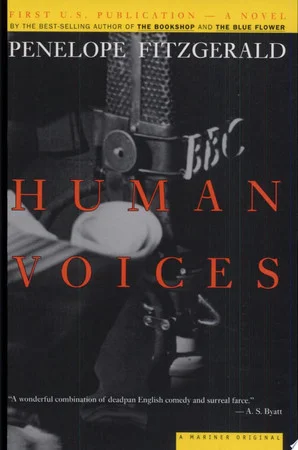
Human Voices
by Fitzgerald, Penelope, Straub · 1999
Own this book?
Catalogue it in your own library: where it is shelved, what you paid, who has borrowed it.
Start your libraryAlready have one? Sign in
Description
Amazon.com
In 1940, as World War II heats up, the BBC is doing its best to fulfill its singular mission: saving Britain from despondency and panic without resorting to lies. "Broadcasting House was in fact dedicated to the strangest project of the war, or of any war, that is, telling the truth." Surrounded by sandbags that are literally going to seed, this London landmark has come to resemble an ocean liner both inside and out. "With the best engineers in the world," Penelope Fitzgerald observes, "and a crew varying between the intensely respectable and the barely sane, it looked ready to scorn any disaster of less than Titanic scale." Though there are no icebergs in Human Voices, Fitzgerald's perfectly pitched 1980 novel, danger does loom on several decks.
For a start, the Department of Recorded Programmes (DRP) is in for a shakeup. Sam Brooks, its director (RPD), has long ruffled the Controllers' feathers owing to his need for several nubile assistants--no wonder his unit is sometimes labeled the Seraglio. This time, however, his penchant for young women isn't the issue. Instead, it's the fact that RPD takes his calling too seriously. For instance, in response to a directive that England's heritage not be lost, he and a crack team once spent two weeks recording a creaky church door in Heather Lickington. At this point, only Jeff Haggard, the Director of Programme Planning (DPP), can save Sam; but having done that for the past 10 years, DPP is suffering from severe BBC battle fatigue.
As Penelope Fitzgerald follows this pair--and several other employees--her novel melds tragedy, surrealism, and satire into one endlessly surprising whole. As ever, she captures the momentous in the smallest moment--the joys of an orange in wartime, the pleasures of piano tuning, and the painful twists of love. When the newest member of the Seraglio makes the mistake (or is it?) of falling for RPD, she does so absolutely, and hers must have been the last generation to fall in love without hope in such an unproductive way. After the war the species no longer found it biologically useful, and indeed it was not useful to Annie. Love without hope grows in its own atmosphere, and should encourage the imagination, but Annie's grew narrower. As is evident in this acute passage, and in virtually every other in Human Voices, Fitzgerald can pivot from sorrow to humor by way of pessimism and desire and then back again. If you so much as blink you'll miss one of the book's key turns or unexpected pleasures. No matter. Penelope Fitzgerald's human comedy always rewards rereading. --Kerry Fried
From Publishers Weekly
Now that Fitzgerald has widened her audience hereABlue Flower was published to rave reviews and the 1997 NBCC fiction awardAHoughton Mifflin is releasing her early novels in paperback. This gracefully controlled and neatly inlaid chronicle of Britain during WWII, published in England in 1980, reflects the author's wartime experiences with the BBC. The beleaguered broadcasters she portrays have chosen truth over consolation; nevertheless they must try to keep their listeners and themselves from despair as the threat of a German invasion mounts and parachute bombs pit the streets. Yet Sam Brooks, RPD (Recorded Programmes Director), lives in a fantasy world of wax discs and nubile women. When he is not trying desperately to capture the sounds of England (spending hundreds of hours and pounds recording the creak of a country church door), Brooks is crying on the shoulder of one or another of his RPAs (Recorded Programmes Assistants), whose "firmness, and roundness, and readiness to be pleased" give him strength. His seraglio comprises Vi Simmons, cheery, practical, with a man at sea who means to marry her; part-French, pregnant, Lise Bernard, abandoned by her beau; Della, tarty, velvet-voiced, bound for defection to the drama department; and the latecomer, Annie Asra, whose uncompromising candor and fragile susceptibility to emotion reverberates as the real voice of Fitzgerald's book. Annie's fate is to fall in love with Brooks, whom s
Topics
More by Fitzgerald, Penelope
Books credited to Fitzgerald, Penelope
Browse similar books