
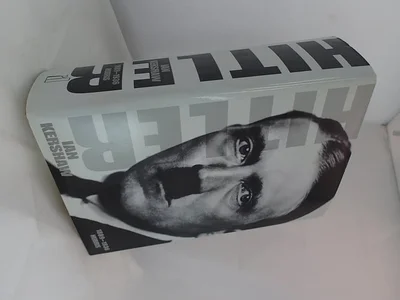
Hitler: 1889-1936: Hubris
by Kershaw, Ian · 1998
Own this book?
Catalogue it in your own library: where it is shelved, what you paid, who has borrowed it.
Start your libraryAlready have one? Sign in
Description
Amazon.co.uk Review Is there anything fresh to be said about Hitler? He is an icon, maybe the icon, of the 20th century. He was a failed artist with Wagnerian fantasies, a slob who could not get up in the morning, but he exposed the frailties of modern civilisation in a way that should still make us giddy. How? Was it his doing, or German society's?
Professor Ian Kershaw has produced a work of definitive scholarship that will be the standard for years to come. It was badly needed; since Alan Bullock's 1952 classic Hitler: A Study In Tyranny and Joachim Fest's Hitler (originally published in 1973) there has been much valuable research, all of which Kershaw seems to have read (there are 200 pages of notes). Add to this the media (and, by extension, public) fascination with the nature of evil, and a resurgent interest in right-wing groups, and this book becomes long overdue.
Kershaw deals rigorously with the bones of his subject's life. He has no truck with psychological padding, and calmly demolishes most of the quasi-facts that have sprung up--if in doubt, he allows space within the chronology. His description of the path to the Chancellorship, which was always more messy than messianic, is painful to behold but gripping to follow, and concludes in 1936 with Hitler at the height of his "Hubris".
This is an important study of the character of power, as clearly written as it is intellectually engaging. --David Vincent
Book Description Why, of all the nationalist-racist fanatics at large in Germany after the First World War did Adolf Hitler find such appeal? How did such an unlikely candidate gain control of the machinery of a complex modern state? Why was his power not curtailed by the traditional ruling classes and what was his personal role in the shaping of policy? In this now classic account, Ian Kershaw takes an innovative approach to the Hitler story. Moving away from conventional biography, he focuses in particular on the nature and mechanics of Hitler's regime to paint a compelling portrait of dictatorial power. --This text refers to an out of print or unavailable edition of this title.
Topics
More by Kershaw, Ian
Books credited to Kershaw, Ian
Browse similar books