
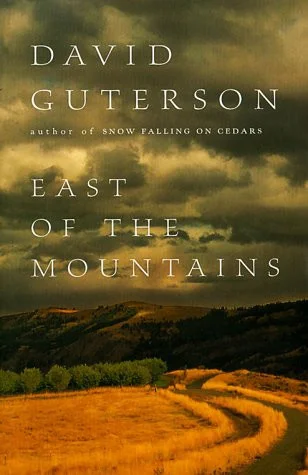
East of the Mountains
by Guterson, David · 1999
Own this book?
Catalogue it in your own library: where it is shelved, what you paid, who has borrowed it.
Start your libraryAlready have one? Sign in
Description
Amazon.com
David Guterson's first novel, Snow Falling on Cedars, was a true ensemble piece, in which even a high-stakes murder trial seemed like a judgment passed on the community at large. In his eloquent second novel, however, the author swings dramatically in the opposite direction. East of the Mountains is the tale of a solitary, 73-year-old Seattle widower. A retired heart surgeon, Ben Givens is an old hand at turning isolation to his advantage, both professionally and personally: "When everything human was erased from existence except that narrow antiseptic window through which another's heart could be manipulated--few were as adroit as Dr. Givens."
Now, however, Ben has been dealt a problem entirely beyond his powers of manipulation: a diagnosis of terminal cancer. With just a few months to live, he sets out across the Cascades for a hunting trip, planning to take his own life once he reaches the high desert. A car crash en route puts an initial crimp in this suicide mission. But the ailing surgeon presses onward--and begins a simultaneous journey into the past. Between present-tense episodes, which demonstrate Ben's cranky commitment to his own extinction, we learn about his boyhood in Washington's apple country, his traumatic war experience in the Italian Alps, and the beginning of his vocation.
Guterson narrates the apple-scented idyll of Ben's childhood in a typically low-key manner--and orchards, of course, are seldom the stuff of melodrama. Still, many of his ambling sentences offer miniature lessons in patience and perception: "They rode back all day to the Columbia, traversed it on the Colockum Ferry, and at dusk came into their orchard tired, on empty stomachs, their hats tipped back, to walk the horses between the rows of trees in a silent kind of processional, and Aidan ran his hands over limbs as he passed them with his horse behind him, the limbs trembling in the wake of his passing, and on, then, to the barn." The wartime episodes, however, are less satisfactory. Clearly Guterson has done his research down to the last stray bullet, but there's a second-hand feeling to the material, which seems less a token of Ben's detachment than the author's.
There is, alas, an additional problem. Begin a story with a planned suicide, and there are exactly two possible outcomes. It would be unfair to reveal Ben's fate. But as the forces of life and death yank him one way, then another, Guterson tends to stack the deck--particularly during a bus ride toward the end of the novel, when Ben's fellow passengers appear to have wandered in from a Frank Capra film. Yet East of the Mountains remains a beautifully imagined work, in which the landscape reflects both Ben's desperation and his intermittent delight. And Guterson knows from the start what his protagonist learns in painful increments: that "a neat, uncomplicated end" doesn't exist on either side of the mountains. --James Marcus
Amazon.com Audiobook Review
In fine tones of uncommon resonance, narrator Don Hastings imbues this beautiful story with a level of compassion and understanding rarely matched. His muscular voice and even delivery are especially well suited to the self-sufficient protagonist, a retired and recently widowed heart surgeon whose spreading cancer spurs him to face death on conditions of his own design. "He reminded himself that by dusk of that day, if everything went according to his plan, he would no longer be in this world." With hunting dogs and rifle, the doctor sets out to revisit the mountains of his youth and to finish his life story with the same tactical precision he had used in the operating room. But a series of chance encounters and unexpected relationships force the dying man to change course and embrace the ambiguities of life, which he normally eschewed. The story is extremely well written, and Hastings delivers an exceptionally strong performance, shading the drama with a weighty realism. (Running time: 9 hours, 6 cassettes) --George Laney --This text refers to the
Audio Cassette edition.
Topics
More by Guterson, David
Books credited to Guterson, David
Browse similar books