
Cereus Blooms at Night: A Novel
by Mootoo, Shani · 1999
Own this book?
Catalogue it in your own library: where it is shelved, what you paid, who has borrowed it.
Start your libraryAlready have one? Sign in
Description
Amazon.com
There is much to admire about Shani Mootoo's first novel, Cereus Blooms at Night. In telling the tale of Mala Ramchandin, her sister, Asha, her childhood sweetheart Ambrose "Boyie" Mohanty, and the other inhabitants of the fictional Caribbean island of Lantanacamara, Mootoo has created a cast of remarkable characters capable of charming the reader. Narrated in part by Tyler, a young male nurse at a home for the elderly, Cereus begins with Mala's admission to the alms house in Paradise--the main city on Lantanacamara--under a cloud of mystery. The old lady won't speak and is suspected of a multitude of crimes, causing the head nurse of the home to keep her in restraints. Only Tyler is willing to care for her; it isn't long before Tyler, an outcast in Paradise because of his sexual orientation, and Mala, a pariah for other reasons, develop an unusual friendship.
For the first half of the book, Mootoo moves easily between Tyler's narrative and a third-person account of Mala's life as a child. The chapters covering the adoption of Mala's father, Chandin Ramchandin, by a white missionary and his wife and Chandin's obsession with his foster sister, Lavinia, offer a telling perspective on race and colonialism; later chapters detailing Chandin's descent into alcoholism, madness, and child abuse are occasionally overwrought, but the strong, child's-eye point of view of young Mala keeps the novel grounded. The second half of Cereus abandons both Tyler and the omniscient narrator, choosing to focus, instead, on Otoh Mohanty, the son of Mala's childhood friend, Boyie. Here Mootoo also introduces, for the first time, elements of the fantastic: a girl who "wills" herself to become a boy; a man who sleeps for weeks at a time, only waking one day each month; a mysterious, locked room that holds a horrifying secret. The result is pure melodrama wrapped up in lovely prose.
Even though the last half of the book seems too suddenly freighted towards the magical and improbable, and the happy ending is a trifle too contrived, Cereus Blooms at Night showcases Shani Mootoo's impressive mastery of language. And in Mala Ramchandin, she has created a tough and tender heroine who commands the reader's interest and sympathy from first page to last. --Alix Wilber --This text refers to an out of print or unavailable edition of this title.
From Publishers Weekly
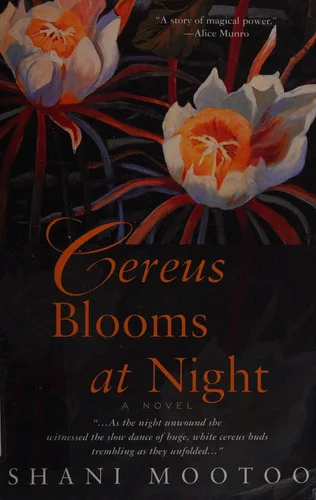
The fecund and fertile cycles of Caribbean life pervade this powerful first novel from Mootoo (Out on Main Street), who invokes all the senses, especially sight and smell, to portray the town of Paradise on the fictional island of Lantanacamara. When Mala Ramchandin, the town madwoman and a rumored murderess, checks into the Paradise Alms Hotel, the only nurse compassionate enough to properly care for her is Tyler, the young narrator of the tale. As a gay man who has always been considered an oddity on the island, he forms an outsider's friendship with Mala. While Tyler slowly gains Mala's trust, readers more clearly see the mosaic that makes up Mala's sad, enigmatic life and come to understand her strange "uncivilized" habits as a form of self-preservation against cruelties endured, including her mother's abandonment, the incestuous relations forced on her by her father and, most haunting of all, the loss (via emigration) of her beloved younger sister. Tyler himself becomes more complex as he reflects on his sexuality. His self-discovery and the secrets of Mala's past might in other hands have become the stuff of melodrama, but Mootoo puts this material to much finer use in a narrative reminiscent of Maryse Conde's work. The seamless plot structure builds to a macabre, satisfying climax and to equally satisfying portraits of two memorable, complex characters against a fascinating, sensuously rendered background. (Sept.) FYI: Cereus Blooms at Night was a finalist for the 1997 Giller Prize, the Chapters/Books in Canada First Novel Award and the Ethel Wilson Fiction Prize. One of Mootoo's paintings appears on the cover; she has exhibited her work internationally. She is also a fil
Topics
Browse similar books