
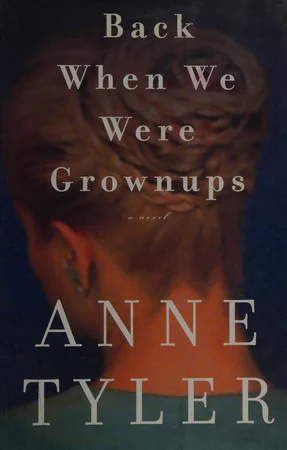
Back When We Were Grownups: A Novel
by Tyler, Anne · 2001
Own this book?
Catalogue it in your own library: where it is shelved, what you paid, who has borrowed it.
Start your libraryAlready have one? Sign in
Description
Amazon.com's Best of 2001
The first sentence of Anne Tyler's 15th novel sounds like something out of a fairy tale: "Once upon a time, there was a woman who discovered she had turned into the wrong person." Alas, this discovery has less to do with magic than with a late-middle-age crisis, which is visited upon Rebecca Davitch in the opening pages of Back When We Were Grownups. At 53, this perpetually agreeable widow is "wide and soft and dimpled, with two short wings of dry, fair hair flaring almost horizontally from a center part." Given her role as the matriarch of a large family--and the proprietress of a party-and-catering concern, the Open Arms--Rebecca is both personally and professionally inclined toward jollity. But at an engagement bash for one of her multiple stepdaughters, she finds herself questioning everything about her life: "How on earth did I get like this? How? How did I ever become this person who's not really me?"
She spends the rest of the novel attempting to answer these questions--and trying to resurrect her older, extinguished self. Should she take up the research she began back in college on Robert E. Lee's motivation for joining the Confederacy? More to the point, should she take up with her college sweetheart, who's now divorced and living within easy striking range? None of these quick fixes pans out exactly as Rebecca imagines. What she emerges with is a kind of radiant resignation, best expressed by 100-year-old Poppy on his birthday: "There is no true life. Your true life is the one you end up with, whatever it may be." A tautology, perhaps, but Tyler's delicate, densely populated novel makes it stick.
Yes, Poppy. There are also characters named NoNo, Biddy, and Min Foo--the sort of saccharine roll call that might send many a reader scampering in the opposite direction. But Tyler knows exactly how to mingle the sweet with the sour, and in Back When We Were Grownups she manages this balancing act like the old pro she is. Even the familiar backdrop--shabby-genteel Baltimore, which resembles a virtual game preserve of Tylerian eccentrics--seems freshly observed. Can any human being really resist this novel? It is, to quote Rebecca, "a report on what it was like to be alive," and an appealingly accurate one to boot. --James Marcus
From Publishers Weekly
On the first page of Tyler's stunning new novel, Rebecca Davitch, the heroine (and heroine is exactly the right word) realizes that she has become the "wrong person." No longer the "serene and dignified young woman" she was at 20, at 53 Rebecca finds she has become family caretaker and cheerleader, a woman with a "style of dress edging dangerously close to Bag Lady." So she tries to do something about it. In the midst of her busy life as mother, grandmother and proprietor of the family business, the Open Arms (she hosts parties in the family's old Baltimore row house), Rebecca attempts to pick up the life she was leading before she married, back when she felt grownup. She visits her hometown in Virginia, locates the boyfriend she jilted and renews her intellectual interests. But as Rebecca ponders the life-that-might-have-been, the reader learns about the life-that-was. At 20, she left college and abandoned her high school sweetheart to marry a man who already had a large family to support. A year later, she had a baby of her own; five years later, her husband died in an auto accident, and she was left to raise four daughters, tend to her aging uncle-in-law and support them all. And a difficult lot they are, seldom crediting Rebecca for holding her rangy family together. Yet like all of Tyler's characters, they are charming in their dysfunction. And much as one feels for Rebecca, much as one wants her to find love, it's difficult to imagine her leaving or upsetting the family order. Tyler (The Accidental Tourist; Breathing Lessons) has a gift for creating endearing characters, but readers should find Rebecca particularly appealing, for despite the blows she takes, she bravely keeps on trying. Tyler also has a gift genius is more like it f
Topics
More by Tyler, Anne
Books credited to Tyler, Anne
Browse similar books