
Babel Tower
by Byatt, A.S. · 1996
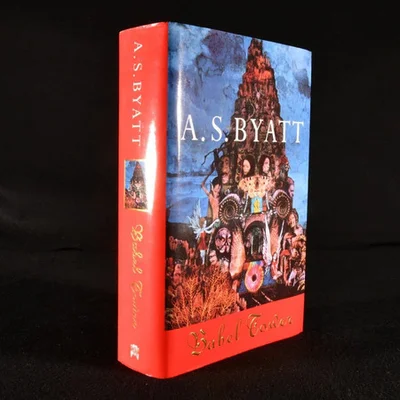
Own this book?
Catalogue it in your own library: where it is shelved, what you paid, who has borrowed it.
Start your libraryAlready have one? Sign in
Description
Amazon.com
Babel Tower follows The Virgin in the Garden and Still Life in tracing Frederica Potter, a lover of books who reflects the author's life and times. It centers around two lawsuits: in one, Frederica -- a young intellectual who has married outside her social set -- is challenging her wealthy and violent husband for custody of their child; in the other, an unkempt but charismatic rebel is charged with having written an obscene book, a novel-within-a-novel about a small band of revolutionaries who attempt to set up an ideal community. And in the background, rebellion gains a major toehold in the London of the Sixties, and society will never be the same.
From Publishers Weekly
One does not usually associate Byatt, who has often worked on a small-even miniature-scale, with the notion of an epic novel; but that, in terms of scope and ambition, is just what she has created here. It is an invigorating spectacle, as well as a welcome reminder of how a fine novelist can illuminate a whole era in ways not even the most skilled social historian can. Set in England in the mid-1960s, the novel focuses on Frederica, an attractive, highly intelligent and bookish young woman who cut a swath at Cambridge University, then married Nigel Reiver, a well-to-do member of the landed gentry with a country house, two doting sisters and a way of life that soon seems utterly stifling to Frederica. Her small son, Leo, passionately loved by both parents, is soon the only vital element in her existence; and when friends from her former life come calling, and are rudely rebuffed by Nigel, Frederica rebels. When Nigel, ever apologetic, but convinced it is for her own good, starts knocking her about, Frederica flees to London, with Leo clinging to her in desperation. Thereafter, the book is an account of the drawn-out custody battle over Leo, climaxing in a divorce hearing that exquisitely renders the issues of a woman's independence. More impressively, it is a riveting account of changing mores, as England begins to emerge from its ancient certainties into the shifting priorities, freedoms and follies of the "Swinging Sixties." Among the manifestations of such changes is a book written by an eccentric, Nietzschean acquaintance of Frederica's-a fantasy, with sado-erotic overtones, about the pleasures and limits of freedom. This book (a reprise of the book-within-a-book device Byatt employed in Possession) becomes the focus of another court case when its author is prosecuted for obscenity. Through the two cases (which leap from the page much more enthrallingly, convincingly and thought-provokingly than most legal thrillers) Byatt represents a whole society trying to come to terms with new values. The narrative is mesmerisingly readable, except for long excerpts from Babbletower, the prosecuted novel, and Frederica's own rather hermetic attempts at self-expression-though even these are perfectly believable in their own right. In many ways, this is a book about language, and how it is used to conceal and reveal (there is a wonderfuly satirical subplot about a commission examining English educational methods). But it also employs language, brilliantly, to create a large cast of characters whose struggles, anxieties and small triumphs are at once specific to a time and place, and universal. Simultaneous Random AudioBook; author tour. Copyright 1996 Reed Business Information, Inc. --This text refers to the
Paperback edition.
Topics
More by Byatt, A.S.
Books credited to Byatt, A.S.
Browse similar books