
Animal Dreams
by Kingsolver, Barbara · 1990
Own this book?
Catalogue it in your own library: where it is shelved, what you paid, who has borrowed it.
Start your libraryAlready have one? Sign in
Description
From the Publisher
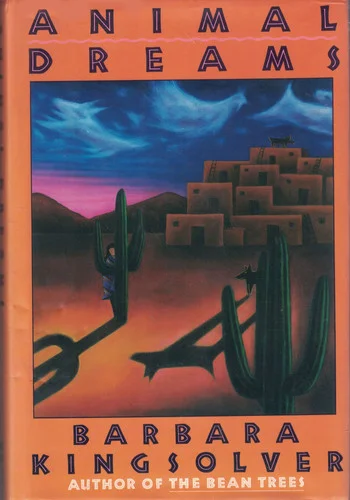
"Animals dream about the things they do in the day time just like people do. If you want sweet dreams, you've got to live a sweet life." So says Loyd Peregrina, a handsome Apache trainman and latter-day philosopher. But when Codi Noline returns to her hometown, Loyd's advice is painfully out of her reach. Dreamless and at the end of her rope, Codi comes back to Grace, Arizona to confront her past and face her ailing, distant father. What the finds is a town threatened by a silent environmental catastrophe, some startling clues to her own identity, and a man whose view of the world could change the course of her life. Blending flashbacks, dreams, and Native American legends, Animal Dreams is a suspenseful love story and a moving exploration of life's largest commitments. With this work, the acclaimed author of The Bean Trees and Homeland and Other Stories sustains her familiar voice while giving readers her most remarkable book yet.
Author Biography:
Barbara Kingsolver was born on April 8, 1955. She grew up "in the middle of an alfalfa field," in the part of eastern Kentucky that lies between the opulent horse farms and the impoverished coal fields. While her family has deep roots in the region, she never imagined staying there herself. "The options were limited-grow up to be a farmer or a farmer's wife."
Kingsolver has always been a storyteller: "I used to beg my mother to let me tell her a bedtime story." As a child, she wrote stories and essays and, beginning at the age of eight, kept a journal religiously. Still, it never occurred to Kingsolver that she could become a professional writer. Growing up in a rural place, where workcentered mainly on survival, writing didn't seem to be a practical career choice. Besides, the writers she read, she once explained, "were mostly old, dead men. It was inconceivable that I might grow up to be one of those myself... "
Kingsolver left Kentucky to attend DePauw University in Indiana, where she majored in biology. She also took one creative writing course, and became active in the last anti-Vietnam War protests. After graduating in 1977, Kingsolver lived and worked in widely scattered places. In the early eighties, she pursued graduate studies in biology and ecology at the University of Arizona in Tucson, where she received a Masters of Science degree. She also enrolled in a writing class taught by author Francine Prose, whose work Kingsolver admires.
Kingsolver's fiction is rich with the language and imagery of her native Kentucky. But when she first left home, she says, "I lost my accent... [P]eople made terrible fun of me for the way I used to talk, so I gave it up slowly and became something else." During her years in school and two years spent living in Greece and France she supported herself in a variety of jobs: as an archaeologist, copy editor, X-ray technician, housecleaner, biological researcher and translator of medical documents. After graduate school, a position as a science writer for the University of Arizona soon led her into feature writing for journals and newspapers. Her numerous articles have appeared in a variety of publications, including The Nation, The New York Times, and Smithsonian, and many of them are included in the collection, High Tide in Tucson: Essays from Now or Never. In 1986 she won an Arizona Press Club award for outstanding feature writing, and in 1995, after the publication of High Tide in Tucson, Kingsolver was awarded an Honorary Doctorate of Letters from her alma mater, De Pauw University.
Kingsolver credits her careers in scientific writing and journalism with instilling in her a writer's discipline and broadening her "fictional possiblities." Describing herself as a shy person who would generally prefer to stay at home with her computer, she explains that "journalism forces me to meet and talk with people I would never run across otherwise."
From 1985 through 1987, Kingsolver was a freelance journalist by day, but she was writing fiction by night. Married to a chemist in 1985, she suffered from inso
Topics
Browse similar books