
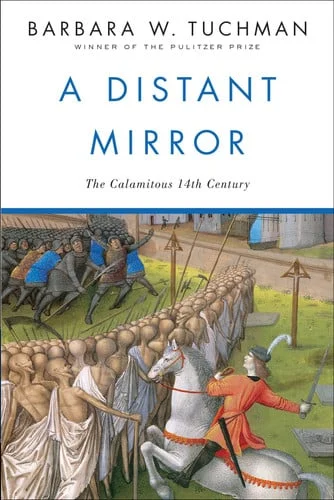
A Distant Mirror: The Calamitous 14th Century
by Tuchman, Barbara W. · 1987
Own this book?
Catalogue it in your own library: where it is shelved, what you paid, who has borrowed it.
Start your libraryAlready have one? Sign in
Description
Amazon.com
In this sweeping historical narrative, Barbara Tuchman writes of the cataclysmic 14th century, when the energies of medieval Europe were devoted to fighting internecine wars and warding off the plague. Some medieval thinkers viewed these disasters as divine punishment for mortal wrongs; others, more practically, viewed them as opportunities to accumulate wealth and power. One of the latter, whose life informs much of Tuchman's book, was the French nobleman Enguerrand de Coucy, who enjoyed the opulence and elegance of the courtly tradition while ruthlessly exploiting the peasants under his thrall. Tuchman looks into such events as the Hundred Years War, the collapse of the medieval church, and the rise of various heresies, pogroms, and other events that caused medieval Europeans to wonder what they had done to deserve such horrors.
From 500 Great Books by Women; review by Lynne Auld
In A Distant Mirror, historian Barbara Tuchman reveals in harrowing detail a "tortured century" with parallels to our own. People in the fourteenth century were subjected to natural and man-made disasters, including the Hundred Years' War, the Crusades, insurrection, lawlessness, the Schism of the Church, massacres of Jewish people, and the Black Death, which claimed the lives of nearly half the population living between India and Iceland. Barbara Tuchman introduces a nobleman, Enguerrand de Coucy (1340-1397), a "whole man in a fractured time," who takes the reader through the century and gives a personalized context through which to understand the events and attitudes of the day. A Distant Mirror goes beyond recording facts to analyze the psychology of the age as it follows Enguerrand from one battle to the next, observing how bankruptcies, crop failures, revolts, and plagues effectively forced people apart so that "emotional response, dulled by horrors, underwent a kind of atrophy..." Suggesting that the "relative emotional blankness of a medieval infancy may account for the casual attitude toward life and suffering," she illustrates the discrepancy between the ideal and the real apparent in upper-class traditions of chivalry, in the practice of Christianity, and in the impossible regulations imposed on nobles, priests, and commoners alike. Pessimism inevitably resulted, for "man had lost confidence in his capacity to construct a good society." This fascinating portrayal of a tumultuous time provides insights into the present and hope for the future. -- For great reviews of books for girls, check out Let's Hear It for the Girls: 375 Great Books for Readers 2-14.
Topics
More by Tuchman, Barbara W.
Books credited to Tuchman, Barbara W.
Browse similar books