
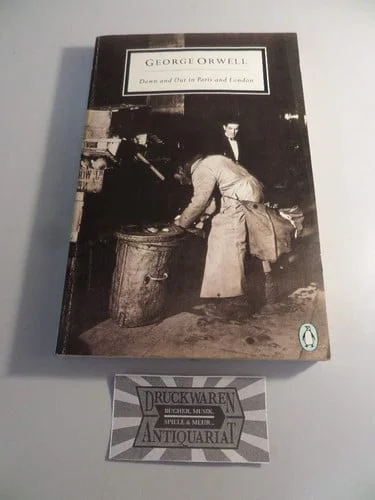
20th Century Down And Out In Paris And London
by Orwell, George, Murphy, Dervla (Foreword) · 1990
Edited by Murphy, Dervla
Own this book?
Catalogue it in your own library: where it is shelved, what you paid, who has borrowed it.
Start your libraryAlready have one? Sign in
Description
Book Description A new edition of this autobiographical episode in Orwell's life, with a new introduction by Dervla Murphy.
Editorial Reviews
Amazon.com Review
What was a nice Eton boy like Eric Blair doing in scummy slums instead of being upwardly mobile at Oxford or Cambridge? Living Down and Out in Paris and London, repudiating respectable imperialist society, and reinventing himself as George Orwell. His 1933 debut book (ostensibly a novel, but overwhelmingly autobiographical) was rejected by that elitist publisher T.S. Eliot, perhaps because its close-up portrait of lowlife was too pungent for comfort.
In Paris, Orwell lived in verminous rooms and washed dishes at the overpriced "Hotel X," in a remarkably filthy, 110-degree kitchen. He met "eccentric people--people who have fallen into solitary, half-mad grooves of life and given up trying to be normal or decent." Though Orwell's tone is that of an outraged reformer, it's surprising how entertaining many of his adventures are: gnawing poverty only enlivens the imagination, and the wild characters he met often swindled each other and themselves. The wackiest tale involves a miser who ate cats, wore newspapers for underwear, invested 6,000 francs in cocaine, and hid it in a face-powder tin when the cops raided. They had to free him, because the apparently controlled substance turned out to be face powder instead of cocaine.
In London, Orwell studied begging with a crippled expert named Bozo, a great storyteller and philosopher. Orwell devotes a chapter to the fine points of London guttersnipe slang. Years later, he would put his lexical bent to work by inventing Newspeak, and draw on his down-and-out experience to evoke the plight of the Proles in 1984. Though marred by hints of unexamined anti-Semitism, Orwell's debut remains, as The Nation put it, "the most lucid portrait of poverty in the English language." --Tim Appelo --This text refers to an out of print or unavailable edition of this title.
Review
Autobiographical work by George Orwell, published in 1933. Orwell's first published book, it contains essays in which actual events are recounted in a fictionalized form. The book recounts that to atone for the guilt he feels about the conditions under which the disenfranchised and downtrodden peoples of the world exist, Orwell decides to live and work as one of them. Dressed as a beggar, he takes whatever employment might be available to a poverty-stricken outcast of Europe. In Paris he lives in a slum and works as a dishwasher. The essay "How the Poor Die" describes conditions at a charity hospital there. In London's East End, he dresses and lives like his neighbors, who are paupers and the poorest of working-class laborers. Dressed as a tramp, he travels throughout England with hoboes and migrant laborers. -- The Merriam-Webster Encyclopedia of Literature --This text refers to an out of print or unavailable edition of this title. See all Editorial Reviews
Topics
More by George Orwell
Books credited to George Orwell
Browse similar books